
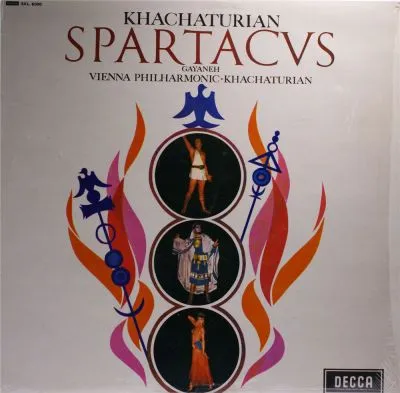
《哈恰图良指挥自己的《斯巴达克斯》《加雅涅》组曲/维也纳爱乐》
簡介
专辑介绍:In 1955 Khatchaturian recorded eight of his own Gayaneh pieces on a lO-inch Columbia disc (33CI041) with the Philharmonia Orchestra, and this version is still in the current catalogue. Four of these same pieces are to be found on the new Vienna Philharmonic record in similarly brilliant performances, plus the Gopak. The latter is musically so inane that i t will tempt no one to forsake the older version; the selling point of this disc is, of course, the selection from Sparlacus, a full-length ballet whose music is new to the catalogue, and i t might have been wiser to devote the whole disc to it . Sportacus was first produced in 1956, and though hardly the 'ballet of the film', i t presumably shares the same plot. The date is 73 BC, and Spartacus, a Roman slave befriended by the beautiful Phrygia, leads a successful rebellion against the forces of oppression. The ballet has been staged in Moscow and Leningrad with what the sleeve-note describes as"great splendour and Hollywood re'alism", and i t seems that Roman chariots and gladiatorial combats are all part of the fun. But 'fun'is the wrong word, the ballet has very serious implications. The composer himself has said that "the heroic personality of Spartacus is in many respects close to the struggle the oppressed colonial peoples of today are waging for their rights". No wonder that he won with this score the Lenin Prize for 1959. Incidentally, the Bolshoi Ballet took the work to the US for their recent visit, where it was not wholly enthusiastically received by the critics. Khachaturian has made three orchestral suites from his Spartaclls music, of which I have seen two. They are not, like most ballet suites, haphazard selections, but more 01" less continuous 'chunks'. Thus the first suite forms the greater part of Scene 6, "The Feast at Crassus", while the second is drawn from Scene 7, "Spartacus's Camp", with the addition of "The Death of Spartacus" from Scene 9. On the present record we are offered the first piece from Suite 2 and Nos. 3-5 from Suite 1. The music is very 'un-modern',and though there is naturally much less Armenian flavour than in Gqyaneh there are still a good many quick 'um-pah um-pah' accompaniments with lots of percussion and brash facile tunes on top. An elaborate leitmotiv system gives one something to think about, and I can well believe the music sounds exciting in its context in the theatre. The last piece on this disc is extremely effective; after some sultry dancing by Gaditanae (slave girls), Spartacus's victory is, so to speak, announced 'off', and the music works up through a Bolero-type crescendo to a final blaze of glory which might well bring the house down. Apart from moments of poor ensemble in the first piece, the playing is good and the quality on both sides is exceptionally vivid in both mono and stereo. R.F.