
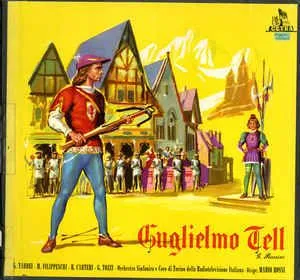
《罗西尼《威廉退尔 歌剧》》
類型专辑
年份1957
簡介
简介 Introduction
四幕大歌剧,儒伊与比斯合作编剧,罗西尼谱曲,1829年8月3日在巴黎歌剧院由阿布奈克指挥首次公演。本剧以席勒的原作为标题,但台词却用的是法语。后世也有以法语、英语为名的。罗西尼写作这出歌剧时,正是他创作力达到顶峰的37岁的中年期。最初写成五幕,但因全剧太长,后删略了第三幕。第四及第五幕合并为第三幕。之后又再修改成为四幕歌剧。
介绍
《威廉·退尔》是罗西尼创作的第三十八部歌剧,同时也是最后一部歌剧。这部歌剧一举奠定了罗西尼在法国音乐家中的地位。
《威廉·退尔》为主角威廉·退尔的名宇,在作曲与首演的法国叫《鸠姆》,在罗西尼的祖国却称为《古烈摩》,但一般都称作《威廉·退尔》。本剧最有名的《序曲》是耳熟能详的名曲,也是音乐会上的珍品,它成为标题音乐式序曲的楷模。
威廉·退尔(德语:Wilhelm Tell、法语:Guillaume Tell、意大利语:Guglielmo Tell)是瑞士传说中的英雄,14世纪居住于乌里州。
威廉·退尔是乌里州的一个农民,哈布斯堡王朝在当地实行暴政,新任总督葛斯勒在中央广场竖立柱子,在柱顶挂着奥地利皇家帽子,并规定居民经过时必须向帽子敬礼,违者将遭到重罚。当时泰尔因没有向帽子敬礼而被捕,葛斯勒要泰尔射中放在泰尔儿子头上的苹果才释放他们,否则两人都会被罚,结果泰尔成功射中苹果。第二箭瞄准葛斯勒总督,泰尔射偏了。当时泰尔回答:“如果我射中儿子,那么第二箭会射中总督心脏。”总督大怒,将泰尔父子囚禁起来。
暴政仍然持续,于是人民发动起义,泰尔在混乱中逃出来,最后泰尔在一次行动中用十字弓杀死葛斯勒。由于人民反抗,使奥地利出兵镇压,不过最终被反抗者击败。
1829年意大利作曲家罗西尼根据德国剧作家席勒的剧作《威廉·退尔》创作了同名歌剧。其中《威廉·退尔序曲》成为一首知名的音乐作品,至今在世界各地被广泛演出。台湾的中国广播公司亦曾于1980-90年代引用此曲开头作为新闻节目的开场音乐。
基本信息
演奏时间
序曲12分、第一幕67分、第二幕47分、第三幕57分、第四幕25分
剧中人物
格斯勒 瑞士总督 男高音
鲁道夫 总督的侍从 男高音
威廉·退尔 瑞士的爱国者 男中音
福尔斯特 瑞士爱国志士 男低音
梅尔希塔尔 族长 男高音
阿诺尔德 族长之子 男高音
洛伊托德 老牧人 男低音
玛蒂尔德 总督的女儿 女高音
黑德维奇 威廉·退尔之妻 女高音
杰米 威廉·退尔之子 女高音
罗伊 渔夫 男高音
士兵指挥官 男中音
农夫、猎人、士兵等。
故事发生于13世纪,地点在瑞士的尤利。
剧情介绍
瑞士在未独立以前,是由神圣罗马帝国下的哈普斯堡家、沙沃伊家和朱宁根家等割据统治的。其中势力最大的是奥国的哈普斯堡家,他们中间有不少施行暴政的恶劣行政官,被管辖的民众正处于水深火热之中。
序曲:由四段构成,如同组曲。全曲描绘阿尔卑斯山下瑞士的自然环境,和瑞士革命志士慷慨激昂视死如归的进军。曲中旋律优美、 节奏活泼宛如一首交响诗。
第一段《黎明》。行板,E小调,3/4拍子。由大提琴宁静优美的独奏开始,随后以大提琴五重奏为主题,描写了瑞士山间平静的黎明。管弦乐伴奏部分,定音鼓以外的打击乐器都沉默不动。
第二段“暴风雨”。快板,2/2拍子。先由第一和第二小提琴预告从远方逼近的疾风密云,随着乐器的增加,音乐似大海的狂啸恕吼,又似天上的狂风暴雨一般。不久,雨过大晴只留下远处的雷声与闪电。这段猛烈的音乐象征着革命志士的自由呼声。
第三段“幽静”。行板,G大调,3/8拍子。狂风暴雨平静后,唱出和平的牧歌。牧人传遍田野的牧笛旋律是由英国管吹出的,长笛也悠闲地应和着,吹出装饰性的助奏。这是风暴过后,一片和平宁静的田园景色。
第四段“终曲”。快饭,E大调,2/4拍子。此处描写争取自由的瑞士革命军英勇快速的进攻,以及民众因革命军的胜利而高声欢呼的情景。这段终曲是由小号独奏引导,铜管奏完序奏后,在刻画华丽节奏上,开始了大家熟悉的进行曲。中段主要由木管歌唱出来,再回到进行曲后跃入全曲的最高潮,最后在兴奋与快乐之情的尾奏上结束。这是革命成功后,庆祝胜利的欢呼。
第一幕 威廉·退尔庭院前的苜蓿湖边
威廉和爱妻黑德维奇带着他们年轻的儿子正在苜蓿湖岸边游玩。邻近的村人们,分别忙着自己的家事。另一边,在举行婚礼的三个住家前,村人们则忙着为热闹的喜庆做各种点缀和布置。这时,威廉的儿子杰米,独自热中于射箭练习。接着,渔夫罗伊唱着情歌《来吧,我的小船》来到。
听到这悠扬的歌声,威廉反而想起了受奥国支配的困顿处境。这时远方传来了角笛的声音,奥国警备队的年轻人阿诺尔德,拉着父亲梅尔希塔尔的手从山上走 下来。梅尔希塔尔是德高望重的族长,他受到村民的爱戴与尊敬,依古时流传的习俗,他是来为订婚的男女祝福的。而梅尔希塔尔的这个儿子尽管已到结婚的年龄, 却不像村中新婚青年男女一样同享父亲的祝福。
阿诺尔德矛盾着,苦恼着,因为他一方面希望帮助威廉和爱国志士们,反抗占领他们国土的奥地利暴君总督格斯勒,但另一方面,他正在跟暴君的女儿玛蒂尔 德恋爱。因为他在一个偶然的机会里,救了玛蒂尔德的性命。他陪伴父亲下山时,听到远方的角笛声,就想到在狩猎的玛蒂尔德,当他准备避开众人的视线溜掉时, 不料被威廉看到,于是他规劝阿诺尔德要以国家的利益为重,阿诺尔德在矛盾的心情下,唱出了这出歌剧中有名的咏叹调:《啊!我爱的玛蒂尔德》之后,又进入了 和威廉的二重唱。不久,新娘和新郎出现了,在梅尔希塔尔主持下婚礼开始。这时远方再次传来号角声,而且越来越近。阿诺尔德坐立不安,他终于逃离了这地方。 从刚才一直注视他动静的威廉,把随后要办的事交代妻子黑德维奇后,就尾随阿诺尔德去了。
这时,村庄的活动还是顺利地进行着,村民们在愉快的唱歌跳舞,气氛十分热闹。在三组新婚夫妻所跳的六人舞之后,又举行射箭比赛,威廉的儿子杰米夺得冠军,他的母亲黑德维奇非常开心。
这时年老的牧羊人洛伊托德喘着气慌张地跑来说:“有一个格斯勒的士兵想强暴我的女儿,我一气之下把他杀死后逃到这儿,希望能借给我一艘船逃到湖的对岸。”但是渔夫罗伊却表示要穿越这急流实在太危险,于是拒绝了洛伊托德。
就在这时候,追兵的声音逐渐接近了。刚好回来的威廉决定让洛伊托德坐上小船,由他划桨穿过岩石耸立的急流。紧接着,格斯勒的侍从鲁道夫,率领一队土兵冲过来,但威廉已经安全地把小船划到对岸。
村民们因他们已经逃过劫难与危险而高兴地欢呼,这却激怒了鲁道夫和土兵们。他们虽然逼问划船的男人是谁,村民们都说不认识。奥国士兵为了惩罚他们,将村里最受尊敬的梅尔希塔尔老人带走。
第二幕 阿尔卑斯山的深谷中,这是历史上有名的组成“瑞土同盟”的段落,据说罗西尼作曲时特别用心。
接近黄昏,此处可以俯视琉森湖的琉特里山岗。猎人们下山回家,做完工的村人们,随着远方传来的钟声唱出了《晚祷之歌》。一队猎人的号角响遍森林,引起牧童们的合唱。格斯勒的女儿玛蒂尔德单独离开猎人群,面带忧郁痴痴地等候恋人阿诺尔德的到来。
现在阿诺尔德占据这位美丽姑娘心田的,她猜想过一会儿阿诺尔德就会来到,于是唱出这首浪漫曲《阴暗的森林,寂寞的荒野》,吐露自己对阿诺尔德的思念。她说:“阴暗的森林,寂寞的原野,比起灿烂的皇宫,我更喜欢你们。能使我重拾安详心灵的,是狂风暴雨般的山巅。知道我心中秘密的,也只有幽谷回声。在我的步伐前散发光芒的晚星呵,请当我的向导吧!”
这时,阿诺尔德终于出现。悲伤寂寞的玛蒂尔德马上转悲为喜,但是她明白彼此身份悬殊、担心会因此伤害她的阿诺尔德,却无法坦然地亲近她。在二重唱 《你从我心灵搜取了秘密》。中,玛蒂尔德发誓说:“无论发生什么事,我都要留在你身旁,爱你不渝。”这些话终于使阿诺尔德放心了。
这时他们发觉有人来了,玛蒂尔德约好再见时间后,急速退场。此时来到这里的是坚强的爱国者威廉和福尔斯特。他们已经偷听到阿诺尔德和玛蒂尔德的对 话,便开始向阿诺尔德灌输祖国爱,但是阿诺尔德却表示准备和玛蒂尔德开此地。这时威廉和福尔斯特才告诉他,父亲梅尔希塔尔已经被格斯勒的部下杀死。
一听到受人尊敬的老父亲,居然无罪被杀,一直只被玛蒂尔德魅力束缚的阿诺尔德的心理阻碍一下子就被打破了。他思念慈祥的父亲,感到的后悔与内疚,脑海了闪现出强烈的复仇之念。三人一起发誓要为瑞士解放运动而献身,勇往直前。
这时从附近森林有很多人的脚步声越来越近。他们到这里集合开会,商谈着如何尽快向该格斯勒反击推翻暴政。当威廉说明大略的计划时,开始有人动摇,有 人提出异议,后来经过威廉的动员,再加上大家知道了梅尔希塔尔老人被杀的沉痛事件,大家的决心更加坚定。聚集而来的人就以威廉等三人的三重唱为中心,唱出 雄壮的男声合唱,发誓逐出外国的统治者,立志消灭暴政,勇敢地高喊着:“拿起武器!”。
第三幕
第一场由于这部歌剧太长了,在舞台的实际演出时,这里时常被省略。此处只有玛蒂尔德和阿诺尔德两人登场,舞台是亚特道夫的总督府邸庭院中荒废的礼拜堂中。
阿诺尔德来向玛蒂尔德告别。从他嘴里得悉阿诺尔德的父亲梅尔希塔尔被格斯勒手下杀死时,玛蒂尔德的眼前突然变成一片漆黑。
阿诺尔德说:“而今父亲被杀害,我们之间的爱只好作罢,无论如何我都要为先父报仇!”但玛蒂尔德再次告诉阿诺尔德说:“我对你的爱永生不渝”,然后劝他尽快离开此地。但是,阿诺尔德还是坚持留在家乡完成复仇心愿,两人确认对方的立场后,终于决定放弃对彼此的爱。
第二场亚特道夫的中心广场。
这一天在此处举行奥地利统治瑞士百年纪念的庆典。总督格斯勒竖立一支竹杆在亚特道夫广场中央,竹杆儿上放着自己的帽子。规定凡是经过广场的市民,都必须向帽子鞠躬致敬,以表示臣服。
这时有三名吉洛尔姑娘献舞,可是这些少女很快成为粗暴士兵调戏的对象,群众的愤怒逐渐高涨。舞蹈的中段,人们以无伴奏唱出极富地方色彩的《狄洛列 瑟》。舞蹈过后,人们又被迫向格斯勒的帽子敬礼,但是只有威廉和儿子杰米,依旧只挺直站着不动,拒绝这可恶的命令。看到这人如此胆大,鲁道夫凭直觉马上想 到帮助老牧羊人逃走的就是他,于是出其不意把威廉和儿子杰米逮捕,并没收了他手上的弓箭。
早已听说威廉是神箭手的格斯勒,突然想到一个残酷的报复行动,那就是从附近的苹果树摘下一个苹果,把它放在杰米头上后,命令威廉用箭射落。为了想救出儿子,威廉泰尔被迫下跪请求格斯勒打消此意,但是被拒绝了。
儿子杰米由于对父亲的本领极为信赖,就鼓励父亲接受挑战,这时威廉将儿子抱在怀里,唱出感人的咏叹调《不能动》,他唱道:
“绝对不能动。把单脚的膝盖稳住在大地上,同时向神祷告,能救父亲的只有神。杰米,请你想一想母亲吧!母亲在等我们回去……”。
杰米回到桩子边,威廉要求取回自己的弓箭,当他在拿脚边的弓时,很灵巧地从箭筒内抽出两支箭,悄悄把其中的一枝藏在上衣里。就在众人屏息注视中,威 廉射出第一枝箭,而且很顺利地把杰米头上的苹果射落,人们立刻高声欢呼。可是格斯勒忽然发现威廉怀里还有―枝箭,总督厉声盘问后,威廉凛然答道:“第一枝 箭如果失败,第二枝箭是准备射杀格斯勒的!”暴怒如雷的格斯勒,马上下命令把他逮捕,并加上锁链。
由于侍女的通知,玛蒂尔德赶来后命令说:“奉皇帝之名,不得逮捕儿童,小孩由我保护!”这时即使是格斯勒,也不得不顺从皇帝的命令。
有关对威廉的处罚则宣布说:
“在今晚将他送往有护城河环绕的鸠斯纳哈特城。广场上的人们齐声哀求,但一点用处也没有,格斯勒的部下则得意地欢呼,而威廉的革命伙伴们却诅咒说:“我们一定要把暴君驱逐出去!”。
第四幕
第一场 梅尔希塔尔家
老梅尔希塔尔被杀后,这个家就任由荒废了。由于战事迫在眉睫,为了向先祖留下的家作最后告别,阿诺尔德悄悄回来,痛苦地思念被格斯勒爪牙杀害的父亲,唱出了:《哦,我的隐密之家》。
这时随着突然发出的奇怪声音,他的伙伴们叫喊着:“复仇”出现。大家告诉他:“威廉?泰尔被关进监牢,我们必须尽快把他救出。”而阿诺尔德则说出父亲和威廉为了推翻暴政储藏的武器存放处。人们发出了震撼山河的叫喊声:“不是胜利,便是死亡!”。
第二场 琉森湖畔,亚克森堡山麓岩石林立的岸边。
狂风呼啸,乌云翻腾,浪花冲到岸边后即刻化成白沫。可能由于威廉?泰尔不幸被捕,受到打击有些狂乱的黑德维奇,表示要去求见格斯勒,这使邻居们惊慌失措。
这时出人意料地传来儿童的说话声,是杰米和玛蒂尔德随即出现。对杰米的勇敢由衷钦佩的玛蒂尔德,决定过来和大家住在这儿,人们感激地说:“为了营救威廉,她决心把自己当作人质。”
玛蒂尔德和杰米告诉黑德维奇,威廉不在亚德道夫,这时候他很可能正在渡过湖水,被送往新建的水牢,唱出优美的女声三重唱《我把你的儿子送回到你的慈爱中》
接着,天空中狂风暴雨即将来临。杰米突然想起父亲曾教他的,为了升起革命信号的营火,就往山上跑去。不久,凶猛的暴风雨真的来了。黑德维奇、玛蒂尔 德和邻居们,同时为威廉的安全向神祷告。这时牧羊人洛伊托德跑来,把众人招呼在一起后说,威廉所乘的船正在波涛中颠簸着。于是众人都冒险在暴风雨中赶往湖 边。
正当这时候,载着格斯勒和威廉的船,拼命要往岸边靠。此刻威廉的锁链被松开了,正在勇敢地驾驶着船只。当这艘船刚刚划上岩石滩时,又被巨浪拉回湖 中。这时,杰米巧妙地把弓箭丢给父亲,船又飘上另一岩石滩,格斯勒从船的另一边走过来时,威廉立刻用箭射穿他的心脏,格斯勒便掉入深深的湖底中。
由于杰米点燃了营火,瑞士联盟的勇士们都聚集后,已经把格斯勒占据的亚特道夫城攻陷,这时一起凯旋归来。暴风雨逐渐远去,暴政被推翻,瑞士重获自由。此刻优美的大自然又展现在众人面前。人们把重享自由后的快乐之情,转化成对神感谢的祷告。
幕落。
摘自:http://www.sin80.com/work/rossini-guillaume-tell
视频网址:http://v.youku.com/v_show/id_XMzU5MTk1ODgw.html
Guillaume Tell (English: William Tell, Italian:Guglielmo Tell) is a French opera in four acts byGioachino Rossini to a libretto by Étienne de Jouyand Hippolyte Bis. Based on Friedrich Schiller's play William Tell, which drew on the William Telllegend, the opera was Rossini's last, although he lived for nearly forty more years. Fabio Luisi said that Rossini planned for William Tell to be his last opera even as he composed it.The overture, in four sections and featuring a depiction of a storm as well as a vivacious finale, the "March of the Swiss Soldiers," is often played.
Charles Malherbe, archivist at the Paris Opéra, discovered the original orchestral score of the opera at a secondhand book seller's shop, resulting in its being acquired by the Paris Conservatoire.
Contents
1Performance history
2Overture
3Roles
4Instrumentation
5Synopsis5.1Act 1
5.2Act 2
5.3Act 3
5.4Act 4
Performance history
It was first performed by the Paris Opéra at the Salle Le Peletier on 3 August 1829, but within three performances cuts were being made and after a year only three acts were performed.The opera's length, roughly four hours of music, and casting requirements, such as the high range required for the tenor part, have contributed to the difficulty of producing the work.When performed, the opera is often cut. Performances have been given in both French and Italian. Political concerns have also contributed to the varying fortunes of the work.
In Italy, because the work glorified a revolutionary figure against authority, the opera encountered difficulties with the Italian censors, and the number of productions in Italy was limited. The Teatro San Carlo produced the opera in 1833, but then did not give another production for around 50 years. The first Venice production, at the Teatro La Fenice, was not until 1856. By contrast, in Vienna, in spite of censorship problems there, the Vienna Court Opera gave 422 performances over the years 1830–1907.As Hofer, or the Tell of the Tyrol, the opera was first given in at Drury Lane in London on 1 May 1830 (in English), with a production in Italian following in 1839 at Her Majesty's, and in French at Covent Garden in 1845.In New York, William Tell was first presented on 19 September 1831.It was revived at the Metropolitan Opera in 1923 with Ponselle and Martinelli, and there were revivals during the 1930s in Milan, Rome, Paris, Berlin and Florence.When the opera was performed at Gran Teatre del Liceu (Barcelona) in 1893, an anarchist threw two Orsini bombsin the theatre.
In the later 20th century there were major productions in Florence (1972), Geneva (1979, 1991), La Scala (1988), Théâtre des Champs-Élysées (1989), Covent Garden (1990), and thenOpéra Bastille (2003)as well as at the Sportspalace in Pesaro (lasting over 5 hours, 1995). In 2010 there was an important revival of the opera, when it opened the Accademia Nazionale di Santa Cecilia's season, under Antonio Pappano.This performance was of the French version, with some cuts to particularly the fourth act (which Pappano noted had been approved by Rossini himself).A live recording of this concert performance was released in 2011, and the production was transferred to The Proms in July of that year, with Michele Pertusi taking on the title role, Patricia Bardon as Hedwige, Nicolas Courjal as Gessler, and Mark Stone as Leuthold. The performance was very well reviewed, and marked the first full performance of the work in the history of the Proms.
According to an anecdote, when an admirer told the composer that he had heard his opera the previous night, Rossini replied "What? The whole of it?".Another version of the story refers only to Act II.In 1864 Offenbach quoted the patriotic trio from Act 2, "Lorsque la Grèce est un champ de carnage" in La Belle Hélène.
Overture
Today, the opera is remembered mostly for its famous overture.Its high-energy finale, "March Of The Swiss Soldiers," is particularly familiar through its use in the American radio and television shows of The Lone Ranger. Several portions of the overture were used prominently in the films A Clockwork Orange and The Eagle Shooting Heroes; in addition,Dmitri Shostakovich quotes the main theme of the finale in the first movement of his 15th symphony. The overture has four parts, each linked to the next:
The Prelude (Dawn) is written only for the cello section (including parts for five soloists), the double basses, and the timpani, in a slow tempo and in E major.
The Storm is a dynamic section played by the full orchestra, with backup from the trombones, in E minor.
The Ranz des Vaches, or call to the dairy cows, features the cor anglais (English horn) and the flute. It is in G major.
The Finale (March Of The Swiss Soldiers) is an ultra-dynamic "cavalry charge" galopheralded by horns and trumpets, and is played by the full orchestra in E major.
Roles
Role Voice type Premiere Cast, 3 August 1829
(Conductor:HenriValentino) Guillaume Tell baritone Henri-Bernard Dabadie Hedwige, his wife mezzo-soprano Mlle Mori Jemmy, his son soprano Louise-Zulme Dabadie Mathilde, a Habsburg princess soprano Laure Cinti-Damoreau Arnold Melchtal tenor Adolphe Nourrit Melchtal, his father bass Bonel Gesler, the Austrian Governor of the cantons ofUri and Schwyz bass Alexandre Prévost Walter Furst bass Nicolas Levasseur Ruodi, a fisherman tenor Alexis Dupont Leuthold, a shepherd bass Ferdinand Prévôt Rodolphe, Captain of Gesler's guard tenor Jean-Étienne-Auguste Massol A hunter baritone Beltrame Pouilley Peasants, shepherds, knights, pages, ladies, soldiers, bridal couples Instrumentation
The instrumentation is:
Woodwinds: a piccolo, a flute, 2 oboes (1st doubles cor anglais), 2 clarinets in A and 2bassoons.
Brass: 4 horns (2 in G and 2 in E), 2 trumpets in E, 3 trombones.
Percussion: 2 timpani, triangle, bass drum and cymbals.
Strings: first violins, second violins, viola, violoncelli and double basses; harp
Synopsis
Place: Austrian-occupied Switzerland
Time: 13th century
Act 1
By the shore of Lake Lucerne, at Bürglen in the canton of Uri
It is the day of the Shepherd Festival, in May, near Lake Lucerne. The action opens on an idyllic scene, with the local peasants busily preparing chalets for three newly wedded couples, singing as they work (Quel jour serein le ciel présage – "What a serene day the sky foretells"). The fisherman, Ruodi, sings a gentle love song from his boat (to orchestral accompaniment from the harps and flutes). William Tell stands apart from the general merriment, however: he is consumed with ennui at Switzerland's continued oppression (Il chante, et l'Helvétie pleure sa liberté – "He sings, and Helvetia mourns her liberty"). His wife and son add their own interpretation of Ruodi's song, presaging the coming nautical dramas.
The activities are interrupted by the ranz des vaches resounding from the hills (often performed by off-stage horns, and echoing in its theme the ranz de vaches in the opera's overture). The horns also signal the arrival of Melchthal, a respected elder of the canton. He is persuaded by Hedwige to bless the couples at the celebration. However, his son Arnold, though of marriageable age, is not participating and is evidently uncomfortable. The entire on-stage cast sings in celebration (Célebrons tous en ce beau jour, le travail, l'hymen et l'amour – "Let all celebrate, on this glorious day, work, marriage and love"). Tell invites Melchthal into his chalet; before they move off, Melchthal chides his son for his failure to marry.
His father's rebuke provokes an outpouring of despair from Arnold: in his recitative we learn of his previous service in the forces of the Austrian rulers, his rescue of Mathilde from an avalanche, and the conflict between his love for her and his shame at serving the "perfidious power". Horn fanfares herald the approach of Gesler, the Austrian governor, whom the Swiss detest, and his entourage. Arnold moves off to greet their arrival, as Mathilde will accompany them, but is stopped by Tell. Inquiring as to where Arnold is going, Tell persuades him to consider joining the planned rebellion against the governor. The expressive duet in which this takes place again shows the tension Arnold feels between his love for Mathilde and the "fatherland" (Ah! Mathilde, idole de mon âme!...Ô ma patrie, mon cœur te sacrifie... – "Ah, Mathilde, idol of my soul...O my fatherland, my heart sacrifices to you..."). By the end of the exchange, Arnold is prepared to confront Gesler the moment he arrives; Tell persuades him to at least let the festival pass in peace, but knows he has gained a convert to the cause of freedom.
The villagers then reassemble, and Melchthal blesses the couples. The blessing is followed by singing, dancing and an archery contest that Tell's young son Jemmy wins with his first shot – a result of his "paternal heritage". It is Jemmy who notices the hurried approach of the pale, trembling and wounded shepherd, Leuthold, who killed one of Gesler's soldiers to defend his daughter and is fleeing the governor's forces. He seeks to escape to the opposite shore, but the cowardly Ruodi refuses to take him in his boat, fearing that the current and the rocks make approaching the opposite bank impossible. Tell returns from searching for the departed Arnold just in time: even as the soldiers approach, calling for Leuthold's blood, Tell takes Leuthold into the boat and out onto the water. Gesler’s guards arrive, led by Rodolphe, who is further incensed by the villagers' prayers and their evident joy at the escape. Melchthal urges the villagers not to tell Rodolphe who it was who aided Leuthold, and is taken prisoner by the guards. As Rodolphe and the soldiers promise retribution (Que du ravage, que du pillage sur ce rivage pèse l'horreur!), Tell's family and friends take comfort in Tell's skills as an archer, which will surely save them.
Act 2
On the heights of Rütli, overlooking the Lake and the Cantons
A hunting party of ladies and gentlemen, accompanied by soldiers, hears the sound of the shepherds returning from the hills as night approaches. Hearing the Governor's horns, they too take their leave. Mathilde, however, lingers, believing she has glimpsed Arnold in the vicinity. She is, like Arnold, anguished by the love she feels for her rescuer, and contemplates it as she sings (Sombre forêt, désert triste et sauvage – "Somber forest, sad and savage wilderness"). Arnold appears, and each confesses to the other their desire for this meeting. In their duet (Oui, vous l'arrachez à mon âme – "Yes, you wring from my soul"), they recognise their mutual passion, but also the obstacles they face. Urging him to "return to the fields of glory", Mathilde assures him of the eventual acceptability of his suit, and leaves at the approach of Tell and Walter. They question Arnold as to why he loves Mathilde, a member of the oppressing Austrians. Arnold, offended by their spying, declares his intention to continue fighting for the Austrians, and thus gain glory, rather than liberty. However, when Walter tells him that Gesler has executed his father Melchthal, Arnold vows revenge (Qu'entends-je? ô crime! – "What do I hear? O crime!").
As the three men affirm their dedication – "to independence or death" – they hear the sound of someone else approaching. It is the men of the canton of Unterwalden coming to join the fight, and describing their journey in a rather gentle refrain (Nous avons su braver). In quick succession, they are joined by the men of Schwyz (En ces temps de malheurs) and Uri (Guillaume, tu le vois). The gathering is complete, and the tone and tempo of the finale rises as the men of the three cantons affirm their willingness to fight or die for the freedom of Switzerland (Jurons, jurons par nos dangers – "Let us swear, let us swear by our dangers"). Plans are made to arm the cantons and to rise up when "the beacons of vengeance burn".
Act 3
Scene 1: A ruined/deserted chapel in the Altdorf palace grounds
Arnold has come to tell Mathilde that, instead of leaving for battle, he is staying to avenge his father, and thereby renouncing both glory and Mathilde. When he tells her that it was Gesler who had his father executed, she denounces his crime, and recognises the impossibility of their love (Pour notre amour, plus d'espérance – "All hope for our love has gone"). Hearing preparations for the coming festival in the palace grounds, they bid a fond farewell to each other (Sur la rive étrangère – "Though upon a foreign shore").
Scene 2: The main square at Altdorf
The day is the hundredth anniversary of Austrian rule in Switzerland. Soldiers sing of the glories of Gesler and the Emperor. In commemoration, Gesler has had his hat placed on top of a pole and the Swiss are ordered and then forced to pay homage to the hat. Gesler commands that there should be dancing and singing to mark the century during which the empire has "deigned to sustain [Swiss] weakness", and a variety of dances and choruses follow. Soldiers have noticed Tell and his son in the crowd, refusing to pay homage to the hat, and drag him forward. Rodolphe recognises him as the man who assisted in Leuthold's escape, and Gesler orders his arrest. In a complex choir and quartet, the soldiers express their hesitation at arresting this famed archer (C'est là cet archer redoutable – "It's that redoubtable archer"), Gesler forces them to act, and Tell urges Jemmy to flee, but he prefers to stay with his father.
Gesler notices the affection Tell has for his son, and has Jemmy seized. Inspired, he devises his test: Tell must shoot an arrow through an apple balanced on Jemmy's head – should he refuse, both of them will die. The assembled Swiss are horrified at this cruelty, but Jemmy urges his father to courage, and refuses to be tied up for the challenge. Resigned, Tell retrieves his bow from the soldiers, but takes two arrows from his quiver and hides one of them. He sings an anguished aria to Jemmy, instructing him (Sois immobile – "Stay completely still"), and the two separate. Finally, Tell draws his bow, shoots, and drives the arrow through the apple and into the stake. The people acclaim his victory, and Gesler is enraged. Noticing the second arrow, he demands to know what Tell intended for it. Tell confesses his desire to kill Gesler with the second arrow, and both he and Jemmy are seized for execution.
Mathilde enters and claims Jemmy in the name of the emperor, refusing to let a child die (Vous ne l'obtiendrez pas – "You will not have him"). Gesler announces his intention to take Tell across Lake Lucerne to the fort at Kusnac/Küssnacht, and there to throw him to the reptiles in the lake. Rodolphe expresses concern at attempting a journey on the lake in the storm, but Gesler intends to force Tell, an expert boatman, to pilot the vessel. They leave, amid conflicting cries of "Anathema on Gesler" from the people, and "Long live Gesler" from the soldiers.
Act 4
Scene 1: Old Melchthal's house
Arnold, aware of Tell's arrest, is dispirited, but, set on revenge, draws strength from being in his father's former home and sings a moving lament (Ne m'abandonne point, espoir de la vengeance... Asile héréditaire... – "Do not abandon me, hope of vengeance... Home of my forefathers"). Would-be "confederates" arrive, sharing and reinforcing his hope of vengeance. Revived, Arnold points them to the weapons cache that his father and Tell had prepared. Seeing the men armed, Arnold launches into the hugely demanding (Amis, amis, secondez ma vengeance – "Friends, friends, assist my vengeance"), replete with multiple and sustained top Cs. Resolved, they leave to storm Altdorf and free Tell.
Scene 2: The rocky shore of Lake Lucerne
Hedwige is wandering by the lake, distraught. She tells the other women she intends to beg Gesler for Tell's life. In the distance, she hears Jemmy calling. Her son enters, along with Mathilde, whom Hedwige entreats for assistance. In some versions, Mathilde, Jemmy and Hedwige sing a moving trio (Je rends a votre amour un fils digne de vous – "I return to your love a son worthy of you"). Jemmy tells his mother that Tell is no longer in Altdorf, but on the lake, at which point Hedwige begins precipitously to mourn (Sauve Guillaume! Il meurt victime de son amour pour son pays – "Save William! He dies a victim of his love for his country"). Leuthold arrives, telling the assembled villagers that the boat carrying Tell, Gesler and the soldiers is being driven towards the rocks by a storm that has broken over the lake – Leuthold believes that the chains have been removed from Tell's hands, so that he might pilot the boat to safety.
The boat pulls into view, and Tell jumps ashore before pushing the boat back. He is amazed to see his house burning in the distance. Jemmy tells him that, for want of a beacon, he set fire to their home but, before doing so, he retrieved his father's bow and arrows. Gesler and the soldiers come into view, intent on recapturing Tell, who kills Gesler with a single shot and the cry, "Let Switzerland breathe!" Walter and a group of confederates arrive, having seen the burning house. Tell informs them of Gesler's death, but cautions that Altdorf still stands. Arnold and his band enter, and break the happy news: they have taken Altdorf. Arnold sees Mathilde, who declares herself "disabused of false grandeur" and ready to join the fight for liberty at his side.
The clouds break, and the sun shines on a pastoral scene of wild beauty. The gathered Swiss fighters and women sing a paean to the magnificence of nature and the return of freedom in a lyrical C major (Tout change et grandit en ces lieux... Liberté, redescends des cieux – "Everything is changing and growing grander in this place... Liberty, descend again from heaven") as the ranz des vaches motif returns once again and finally.
From:https://en.wikipedia.org/wiki/William_Tell_(opera)
The William Tell Overture is the overture to the operaWilliam Tell (original French title Guillaume Tell), whose music was composed by Gioachino Rossini. William Tellpremiered in 1829 and was the last of Rossini's 39 operas, after which he went into semi-retirement, although he continued to compose cantatas, sacred music and secular vocal music. The overture is in four parts, each following without pause.
There has been repeated use (and sometimes parody) of parts of this overture in both classical music and popular media, most famously as the theme music for The Lone Ranger in radio, television and film.It was also used as the theme music for the British television series The Adventures of William Tell.
Franz Liszt prepared a piano transcription of the overture in 1838 (S.552) which became a staple of his concert repertoire.There are also transcriptions by other composers, including versions by Louis Gottschalk for two and four pianos and a duet for piano and violin.
Contents
1Instrumentation
2Structure
Instrumentation
The overture is scored for: a piccolo, a flute, two oboes (first or second oboe doubles acor anglais), two clarinets in A, two bassoons, four French horns in G and E, two trumpetsin E, three trombones, timpani, triangle, bass drum and cymbals, and strings.
Structure
The overture, which lasts for approximately 12 minutes, paints a musical picture of life in the Swiss Alps, the setting of the opera.It was described by Hector Berlioz, who usually loathed Rossini's works, as "a symphony in four parts."But unlike an actual symphonywith its distinct movements, the overture's parts transition from one to the next without a break.
Prelude: Dawn
The prelude is a slow passage in E major, scored for five solo cellos accompanied by double basses. It begins in E minor with a solo cello which is in turn 'answered' by the remaining cellos and the double basses. An impending storm is hinted at by two very quiet timpani rolls resembling distant thunder. The section ends with a very high sustained note played by the first cello.
Storm
This dynamic section in E minor is played by the full orchestra. It begins with the violinsand violas. Their phrases are punctuated by short wind instrument interventions of three notes each, first by the piccolo, flute and oboes, then by the clarinets and bassoons. The storm breaks out in full with the entrance of the French horns, trumpets, trombones, andbass drum. The volume and number of instruments gradually decreases as the storm subsides. The section ends with the flute playing alone.
Ranz des vaches
This pastorale section in G major signifying the calm after the storm begins with a Ranz des vaches or "Call to the Cows", featuring the cor anglais (English horn). The English horn then plays in alternating phrases with the flute, culminating in a duet with the triangle accompanying them in the background.The melody appears several times in the opera, including the final act, and takes on the character of a leitmotif.
This segment is often used in animated cartoons to signify daybreak, most notably in Walt Disney's The Old Mill.
Finale: March of the Swiss Soldiers
The finale, often called the "March of the Swiss Soldiers" in English, is in E major like the prelude, but it is an ultra-dynamic galop heralded by trumpets and played by the full orchestra. It alludes to the final act, which recounts the Swiss soldiers's victorious battle to liberate their homeland from Austrian repression. Although there are no horses or cavalry charges in the opera, this segment is often used in popular media to denote galloping horses, a race, or a hero riding to the rescue. Its most famous use in that respect is as the theme music for The Lone Ranger; that usage has become so famous that the term "intellectual" has been defined as "a man who can listen to the William Tell Overture without thinking of the Lone Ranger."The Finale is quoted by Dmitri Shostakovich in the first movement of his Symphony No. 15.
From:https://en.wikipedia.org/wiki/William_Tell_Overture