
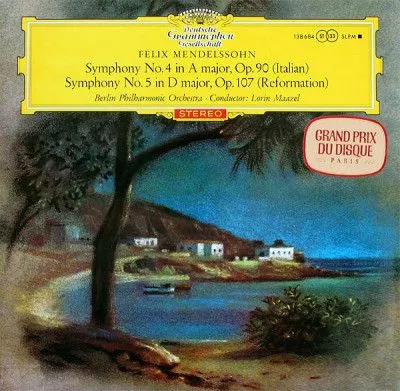
《门德尔松《第4交响曲“意大利”》 《第5交响曲,D大调为管弦乐队而作“宗教改革”》 /马泽尔指挥 ,柏林爱乐乐团 》
類型专辑
年份1961
簡介
Symphony No. 4 (Mendelssohn)
TheSymphony No. 4in A major,Op.90, commonly known as theItalian,[1]is an orchestral symphony written by German composerFelix Mendelssohn.
History
The work has its origins (as had the composer'sScottish3rd SymphonyandThe Hebridesoverture) in the tour of Europe which occupied Mendelssohn from 1829 to 1831. Its inspiration is the colour and atmosphere of Italy, where Mendelssohn made sketches but left the work incomplete. Below is a snippet of a letter he wrote to his father:
This is Italy! And now has begun what I have always thought... to be the supreme joy in life. And I am loving it. Today was so rich that now, in the evening, I must collect myself a little, and so I am writing to you to thank you, dear parents, for having given me all this happiness.[2]
In February he wrote from Rome to his sisterFanny,
TheItaliansymphony is making great progress. It will be the jolliest piece I have ever done, especially the last movement. I have not found anything for the slow movement yet, and I think that I will save that for Naples.
TheItalian Symphonywas finished in Berlin on 13 March 1833, in response to an invitation for a symphony from theLondon (now Royal) Philharmonic Society; he conducted the first performance himself in London on 13 May 1833 at a London Philharmonic Society concert. The symphony's success, and Mendelssohn's popularity, influenced the course of British music for the rest of the century.[3]TheGermania Musical Societyof Boston gave the first performance in the United States, on 1 November 1851, withCarl Bergmannconducting.[4]
Mendelssohn himself, however, remained dissatisfied with the composition, which cost him, he said, some of the bitterest moments of his career; he revised it in 1834[5]and even planned to write alternative versions of the second, third, and fourth movements. He never published the symphony, and it appeared in print only in 1851;[6]thus it is numbered as his "Symphony No. 4", even though it was in fact the third he composed.
摘自:https://en.wikipedia.org/wiki/Symphony_No.4(Mendelssohn)
Symphony No. 5 (Mendelssohn)
TheSymphony No. 5in D major/D minor,Op.107, known as theReformation, was composed byFelix Mendelssohnin 1830 in honor of the 300th anniversary of the Presentation of theAugsburg Confession. The Confession is a key document ofLutheranismand its Presentation toEmperor Charles Vin June 1530 was a momentous event of theProtestant Reformation. This symphony was written for a full orchestra and was Mendelssohn's second extended symphony. It was not published until 1868, 21 years after the composer's death – hence its numbering as '5'. Although the symphony is not very frequently performed, it is better known today than when it was originally published. Mendelssohn's sister,Fanny Mendelssohn Hensel, chose the nameReformationSymphony.
History
In December 1829, a year before the King ofPrussiaFrederick William IIIhad even announced the tercentennial Augsburg celebrations, Mendelssohn began work on the Reformation Symphony. Mendelssohn hoped to have it performed at the festivities in Berlin which took place on 25 June 1830. He had intended to finish the composition by January 1830 and tour for four months before the celebrations began in June. However, his ill health caused the Reformation Symphony to take longer to compose than he had initially expected. In late March the symphony was still in a state of fabrication, and in an inauspicious turn of events Mendelssohn caught measles from his sisterRebecka. With a further delay of the composing and touring, Mendelssohn eventually completed the symphony in May. Unfortunately, it was too late for the Augsburg commission to recognize the symphony for the celebrations.
Some authorities have suggested thatantisemitismmay have played a role in the symphony's absence from Augsburg. But the successful competitor,Eduard Grell, had already established himself as a competent and successful composer who was gaining considerable popularity in Berlin. Grell was extremely conservative in his compositions; his piece for male chorus perhaps matched what the Augsburg celebrations demanded, in contrast to Mendelssohn's extensive symphony, which may have been thought inappropriate at the time.[2]
Mendelssohn resumed his touring immediately after he had completed the Reformation Symphony. In Paris, in 1832,François Antoine Habeneck's orchestra turned the work down as 'too learned'; the music historian Larry Todd suggests that perhaps they also felt it to be too Protestant.[3]He did not offer the symphony for performance atLondon. During the summer of 1832, Mendelssohn returned to Berlin where he revised the symphony. Later that year a performance of the Reformation Symphony finally took place.[4]By 1838 however Mendelssohn regarded the symphony as 'a piece ofjuvenilia', and he never performed it again. It was not performed again until 1868, more than 20 years after the composer's death.