
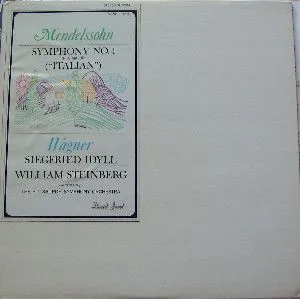
《瓦格纳《齐格弗里德牧歌,E大调》 /门德尔松《第4交响曲“意大利”》 /斯坦贝格指挥 ,匹兹堡交响乐团 》
簡介
Symphony No. 4 (Mendelssohn)
TheSymphony No. 4in A major,Op.90, commonly known as theItalian,[1]is an orchestral symphony written by German composerFelix Mendelssohn.
History
The work has its origins (as had the composer'sScottish3rd SymphonyandThe Hebridesoverture) in the tour of Europe which occupied Mendelssohn from 1829 to 1831. Its inspiration is the colour and atmosphere of Italy, where Mendelssohn made sketches but left the work incomplete. Below is a snippet of a letter he wrote to his father:
This is Italy! And now has begun what I have always thought... to be the supreme joy in life. And I am loving it. Today was so rich that now, in the evening, I must collect myself a little, and so I am writing to you to thank you, dear parents, for having given me all this happiness.[2]
In February he wrote from Rome to his sisterFanny,
TheItaliansymphony is making great progress. It will be the jolliest piece I have ever done, especially the last movement. I have not found anything for the slow movement yet, and I think that I will save that for Naples.
TheItalian Symphonywas finished in Berlin on 13 March 1833, in response to an invitation for a symphony from theLondon (now Royal) Philharmonic Society; he conducted the first performance himself in London on 13 May 1833 at a London Philharmonic Society concert. The symphony's success, and Mendelssohn's popularity, influenced the course of British music for the rest of the century.[3]TheGermania Musical Societyof Boston gave the first performance in the United States, on 1 November 1851, withCarl Bergmannconducting.[4]
Mendelssohn himself, however, remained dissatisfied with the composition, which cost him, he said, some of the bitterest moments of his career; he revised it in 1834[5]and even planned to write alternative versions of the second, third, and fourth movements. He never published the symphony, and it appeared in print only in 1851;[6]thus it is numbered as his "Symphony No. 4", even though it was in fact the third he composed.
摘自:https://en.wikipedia.org/wiki/Symphony_No.4(Mendelssohn)
Siegfried Idyll
TheSiegfried Idyll,WWV103, byRichard Wagneris asymphonic poemforchamberorchestra.
Background
Wagner composed theSiegfried Idyllas a birthday present to his second wife,Cosima, after the birth of their sonSiegfriedin 1869. It was first performed on Christmas morning, 25 December 1870,[1]by a small ensemble of theTonhalle Orchester Zürichon the stairs of their villa atTribschen(today part ofLucerne), Switzerland. Cosima awoke to its opening melody. ConductorHans Richterlearned thetrumpetin order to play the brief trumpet part, which lasts only 13measures, in that private performance, reportedly having sailed out to the centre ofLake Lucerneto practise, so as not to be heard.[2]
The original title wasTriebschen Idyll with Fidi's birdsong and the orange sunrise, as symphonic birthday greeting. Presented to his Cosima by her Richard."Fidi" was the family's nickname for their son Siegfried. It is thought that the birdsong and the sunrise refer to incidents of personal significance to the couple.
Wagner's operaSiegfried, which was premiered in 1876, incorporates music from theIdyll. Wagner adapted the material from an unfinished chamber piece into theIdyllbefore giving the theme, to Brünnhilde in the opera's final scene, the "Ewig war ich" love duet between Brünnhilde and Siegfried.[3]This theme, Wagner claimed, came to him during the summer of 1864 at the Villa Pellet, overlookingLake Starnberg, where he and Cosima consummated their union. He is contradicted, however, by his own obsessive record keeping: the melody was composed that November 14, when he was alone in Munich.[4]The work also uses a theme based on the Germanlullaby, "Schlaf, Kindlein, schlaf", which was jotted down by Wagner on New Year's Eve 1868 and introduced by a solooboe.[5]Ernest Newman discovered it was linked to the Wagners' older daughterEva. This and other musical references, whose meaning remained unknown to the outside world for many years, reveal the idyll's levels of personal significance for both Wagner and Cosima.[6]
Wagner originally intended theSiegfried Idyllto remain a private piece.[7]However, due to financial pressures, he decided to sell the score to publisherB. Schottin 1878.[3]In doing so, Wagner expanded theorchestrationto 35 players to make the piece more marketable.[3]The original piece is scored for a small chamber orchestra of 13 players:flute,oboe, twoclarinets,bassoon, twohorns,trumpet, twoviolins,viola,celloanddouble bass. The piece is commonly played today by orchestras with more than one player on each string part. Modern performances are much slower than those of earlier years.[8]