
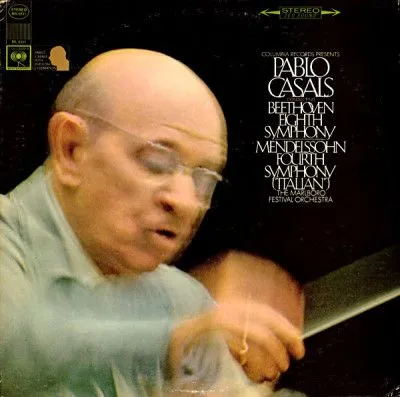
《贝多芬《F大调第8交响曲》 /门德尔松《第4交响曲“意大利”》 /卡萨尔斯指挥 ,万宝路音乐节室内乐团 》
簡介
Symphony No. 4 (Mendelssohn)
TheSymphony No. 4in A major,Op.90, commonly known as theItalian,[1]is an orchestral symphony written by German composerFelix Mendelssohn.
History
The work has its origins (as had the composer'sScottish3rd SymphonyandThe Hebridesoverture) in the tour of Europe which occupied Mendelssohn from 1829 to 1831. Its inspiration is the colour and atmosphere of Italy, where Mendelssohn made sketches but left the work incomplete. Below is a snippet of a letter he wrote to his father:
This is Italy! And now has begun what I have always thought... to be the supreme joy in life. And I am loving it. Today was so rich that now, in the evening, I must collect myself a little, and so I am writing to you to thank you, dear parents, for having given me all this happiness.[2]
In February he wrote from Rome to his sisterFanny,
TheItaliansymphony is making great progress. It will be the jolliest piece I have ever done, especially the last movement. I have not found anything for the slow movement yet, and I think that I will save that for Naples.
TheItalian Symphonywas finished in Berlin on 13 March 1833, in response to an invitation for a symphony from theLondon (now Royal) Philharmonic Society; he conducted the first performance himself in London on 13 May 1833 at a London Philharmonic Society concert. The symphony's success, and Mendelssohn's popularity, influenced the course of British music for the rest of the century.[3]TheGermania Musical Societyof Boston gave the first performance in the United States, on 1 November 1851, withCarl Bergmannconducting.[4]
Mendelssohn himself, however, remained dissatisfied with the composition, which cost him, he said, some of the bitterest moments of his career; he revised it in 1834[5]and even planned to write alternative versions of the second, third, and fourth movements. He never published the symphony, and it appeared in print only in 1851;[6]thus it is numbered as his "Symphony No. 4", even though it was in fact the third he composed.
摘自:https://en.wikipedia.org/wiki/Symphony_No.4(Mendelssohn)
Symphony No. 8 (Beethoven)
TheSymphony No. 8inF major,Op.93 is a symphony in four movements composed byLudwig van Beethovenin 1812. Beethoven fondly referred to it as "my little Symphony in F," distinguishing it from hisSixth Symphony, a longer work also in F.[1]
The Eighth Symphony is generally light-hearted, though not lightweight, and in many places cheerfully loud, with many accented notes. Various passages in the symphony are heard by some listeners to be musical jokes.[2]As with various other Beethoven works such as theOpus 27 piano sonatas, the symphony deviates fromClassicaltradition in making the last movement the weightiest of the four.
Composition, premiere and reception
The work was begun in the summer of 1812, immediately after the completion of theSeventh Symphony.[3]At the time Beethoven was 41 years old. AsAntony Hopkinshas noted, the cheerful mood of the work betrays nothing of the grossly unpleasant events that were taking place in Beethoven's life at the time, which involved his interference inhis brother Johann's love life.[3]The work took Beethoven only four months to complete,[3]and is, unlike many of his works, without dedication.
The premiere took place on 27 February 1814, at a concert in theRedoutensaal, Vienna, at which the Seventh Symphony (which had been premiered two months earlier) was also played.[4]Beethoven was growing increasingly deaf at the time, but nevertheless led the premiere. Reportedly, "the orchestra largely ignored his ungainly gestures and followed theprincipal violinistinstead."[5]
When asked by his pupilCarl Czernywhy the Eighth was less popular than the Seventh, Beethoven is said to have replied, "because the Eighth is so much better."[6]A critic wrote that "the applause it received was not accompanied by that enthusiasm which distinguishes a work which gives universal delight; in short—as the Italians say—it did not create a furor." Beethoven was angered at this reception.[7]George Bernard Shaw, in his capacity as a music critic, agreed with Beethoven's assessment of the work, writing that indeed, "In all subtler respects the Eighth is better [than the Seventh]."[8]More recently,Jan Swaffordhas described the Eighth as "a beautiful, brief, ironic look backward to Haydn and Mozart."[9]Martin Geckhas commented on the authenticity of the Eighth, noting that it contains "all the relevant hallmarks, including motivic and thematic writing notable for its advanced planning, defiant counterpoint, furious cross-rhythms, sudden shifts frompianotoforte, and idyllic and even hymnlike episodes."[10]But other critics have been divided in their judgement.