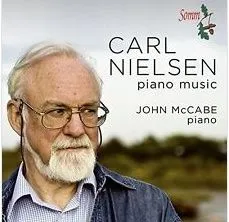
约翰·麦凯布 (John McCabe)
约翰·麦凯布
J·McCabe / J·麦凯布地區英国
類型个人
職業钢琴
藝人資料
John McCabe, CBE (21 April 1939 – 13 February 2015) was a British composer and pianist. He created works in many different forms, including symphonies, ballets, and solo works for the piano. He served as principal of theLondon College of Music from 1983 to 1990. Guy Rickards described him as "one of Britain’s finest composers in the past half-century" and "a pianist of formidable gifts and wide-ranging sympathies." Early life and education McCabe was born in Huyton, Liverpool, Merseyside on 21 April 1939.His father was a physicist.McCabe was badly burned in an accident when he was a child and was home schooled for eight years. During this time, McCabe said that there was "a lot of music in the house", which inspired his future career.[5] He explained "My mother was a very good amateur violinist and there were records and printed music everywhere. I thought that if all these guys – Beethoven, Brahms, Schubert – can do it, then so can I!" McCabe later suppressed his early symphonies, believing they were not good enough.He subsequently attended Liverpool Institute. Career Composer A prolific composer from an early age, McCabe had written thirteen symphonies by the time he was eleven (Rickards 2001). After studies at the Royal Manchester College of Music (now the Royal Northern) and in Munich, with composers Thomas Pitfield, Harald Genzmer and others, he embarked upon a career as both a composer and a virtuoso pianist.Guy Rickards considers McCabe's early works to have been overlooked because he was perceived as a pianist rather than a composer.One of his early successes was the orchestral song cycle Notturni ed Alba (1970), based on a set of poems in medieval Latin about the theme of night, which was described by Gramophone as "an intoxicating creation, full of tingling atmosphere and slumbering passion".His Concerto for Orchestra (1982) brought him international recognition,but it was not until the 1990s that he came to be viewed primarily as a composer, with the successes of the piano work Tenebrae (1992–3), which marked the deaths in 1992 of musicians Sir Charles Groves, William Mathias and Stephen Oliver, and was written for Barry Douglas; his Fourth Symphony, Of Time and the River (1993–4); and his third ballet Edward II (1995),[1] which won the 1998 Barclays Theatre Award. He worked in almost every genre, though large-scale forms lie at the heart of his catalogue with seven symphonies, two dozen concertante works and eight ballet scores to his name (Anon. 2014). His numerous concerti include four for his own instrument, the piano (1966–76), three for one or twoviolins (1959, 1980, 2003) as well as for viola (1962), harpsichord (1968), oboe d'amore (1972), clarinet (1977), orchestra (1982), trumpet (1987) and flute (1990), and double concertos for viola and cello (1965) and clarinet and oboe (1988). His chamber works include seven string quartets, the third of which (1979) was inspired by the landscape of the Lake District.[3] His solo instrumental music was mainly written for the piano; he composed 13 studies for the instrument, including Gaudí (1970), inspired by the architect; Mosaic (1980), inspired by Islamic art; and a series of seven (2000–9) each explicitly drawing inspiration from a different composer.Other significant piano works include the Haydn Variations(1983), written to commemorate the 250th anniversary of Haydn's birth. McCabe's style evolved gradually from an initial lyrical constructivism through a serialist phase, with a fascination with repetitive patterns leading to a more complex combination of processes in order to achieve more subtle forms of continuity (Maycock 1989, 386). Rickards states that his influences included Vaughan Williams, Britten, Tippett and Karl Amadeus Hartmann,[1] and he was also influenced by non-classical music including rock and jazz. He had a long-lasting association with the Presteigne Festival. Pianist McCabe first became known as a pianist. His repertoire was wide, from pre-classical to modern composers.He specialised in twentieth-century music, particularly by English composers. He gave the UK premiere of John Corigliano's Piano Concerto.Another specialism was the music of Haydn; McCabe's "definitive"mid-1970s recording of Haydn's complete piano sonatas was described by Gramophone as "one of the great recorded monuments of the keyboard repertoire."He recorded several CDs with the cellist Julian Lloyd Webber. Teacher and administrator From 1965 to 1968 McCabe was pianist‐in‐residence at University College, Cardiff (Kennedy 2006). He served as principal of the London College of Music from 1983 to 1990, where his efforts to enhance the college's profile resulted in its merging with Thames Valley University.[1][10] He also held visiting professorships at the universities of Melbourne, Australia and Cincinnati, USA during the 1990s.Among his notable pupils is Canadian composer Gary Kulesha. https://en.wikipedia.org/wiki/John_McCabe_(composer)