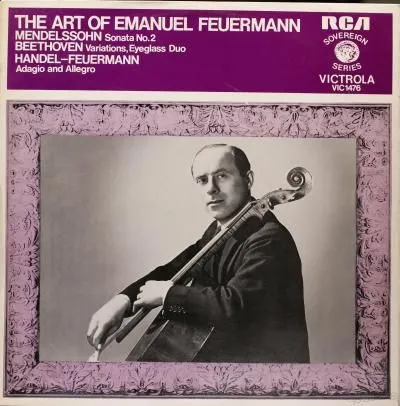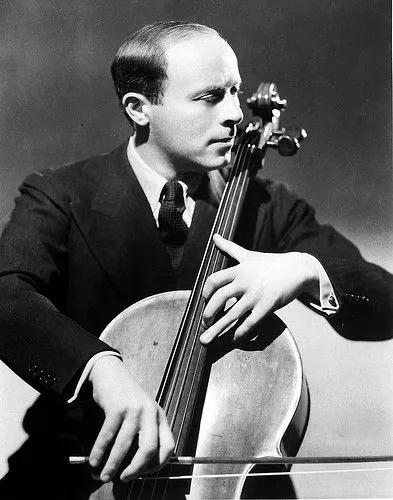
Emanuel Feuermann 艾曼纽·费尔曼
艾曼纽·费尔曼
E·Feuermann / E·费尔曼地區乌克兰
類型个人
職業大提琴
藝人資料
艾曼纽·费尔曼(Emanuel Feuermann),成名于美国的奥地利大提琴家。当费尔曼于公元1935年于美国初次登台时,听众群里甚至也挤满了前来一睹风采的同行大提琴家们。音乐会后的评论里,有一段写着:“对费尔曼先生来说,困难的演奏技巧这个名词并不存在,甚至在那些成名的大提琴大师们都会感觉到踌躇的困难桥段!1938年,一位英国乐评在专门讨论弦乐的杂志《The Strad》上发表了一篇聆听费尔曼演奏会后记,他说“他绝对是当代第一的大提琴家(除了卡萨尔斯之外)。在费尔曼里,你能听到世界首屈一指的壮丽的大提琴艺术!容我说,他是大提琴家里的维尼亚夫斯基。”
摘自:http://www.sohu.com/a/23609607_197790
English Introduction
Emanuel Feuermann(November 22, 1902– May 25, 1942) was an internationally celebratedcellistin the first half of the 20th century.
Feuermann was born in 1902 in Kolomyja, Galicia, Austro-Hungarian Empire (now Kolomyya, Ukraine) to Jewish parents. Both of his parents were amateur musicians. His father, who played the violin and cello, was his first teacher. His older brother Sigmund was also musically talented, and their little sister, Sophie (b. January 1908) was the piano prodigy in the family. Their father decided to move the family to Vienna in 1907 for Sigmund to start his professional career there. At the age of nine, Emanuel received lessons from Friedrich Buxbaum, principal cello of the Vienna Philharmonic, and then studied with Anton Walter at the Music Academy in Vienna. In February 1914, the eleven-year-old prodigy made his concert debut, playing Joseph Haydn's Cello Concerto in D major with the Vienna Philharmonic under Felix Weingartner.
In 1917, Feuermann went to Leipzig to study with legendary cellist Julius Klengel. In 1919 cellist Friedrich Wilhelm Ludwig Grützmacher (1866–1919), the nephew of Friedrich Wilhelm Grützmacher, died, and Klengel recommended Feuermann for Grützmacher's position at the Gürzenich Conservatory in Cologne. He was also appointed principal cellist of the Gürzenich Orchestra, by its conductor (who was also the conservatory director), Hermann Abendroth. Feuermann became cellist of the Bram Elderling Quartet. At that time, he also joined a short-lived piano trio with his brother and pianist-conductor Bruno Walter. In 1929, Feuermann became professor at the Musikhochschule in Berlin and taught there for the next four years. He performed during this time with violinists Carl Flesch, Szymon Goldberg, Joseph Wolfsthal and composer Paul Hindemith, the latter playing viola in a string trio with Feuermann and Wolfsthal (later Goldberg; see below). He also performed with Jascha Heifetz, William Primrose and Arthur Rubinstein.
On April 3, 1933, the newly installed Nazi regime dismissed him from his position at the Berlin Conservatory due to his Jewish origin. He moved to London along with Goldberg and Hindemith, where the trio recorded Beethoven's early Serenade in D major for string trio, Op. 8, and a string trio by Hindemith, for Columbia Records. He toured Japan and the United States then returned to London, where he married Eva Reifenberg (a cousin of Katja Andy) in 1935, with whom he had a daughter, Monica. Following the premiere of Arnold Schoenberg's Cello Concerto under Sir Thomas Beecham he lived for some time in Zürich, but happened to be in Vienna at the time of the 1938 Anschluss. Violinist Bronisław Huberman helped Feuermann and his family escape to BritishPalestine. From there they moved to the United States later that year.
He taught privately, and at the Curtis Institute of Music in Philadelphia, until his death. During these years he collaborated with the pianist Vladimir Sokoloff. Among his notable pupils were Bernard Greenhouse, Suzette Forgues Halasz, Robert Lamarchina, Alan Shulman, David Soyer and August Wenzinger. In the United States, he made several celebrated chamber-music recordings with Heifetz, Rubinstein and others. His relationship with Hindemith suffered when the latter chose Gregor Piatigorsky to premiere his Cello Concerto.
Feuermann died in New York City due to complications during surgery on May 25, 1942, at the age of 39.
Klengel wrote of Feuermann, "Of all those who have been entrusted to my guardianship, there has never been such a talent...our divinely favoured artist and lovable young man." Heifetz declared that talent like Feuermann's comes once every one hundred years. Indeed, after Feuermann's untimely death it took seven years for Heifetz to collaborate with another cellist, Gregor Piatigorsky.
Artur Rubinstein was equally emphatic: "He became for me the greatest cellist of all times, because I did hear Pablo Casals at his best. He (Casals) had everything in the world, but he never reached the musicianship of Feuermann. And this is a declaration." If one can grade (approximately) music playing into technical, artistic, philosophical and divine levels, in his full maturity, Feuermann had touched on the philosophical level. Given enough time, he might touch on the divine level on playing cello. His untimely death never allowed him to reach there. Both Heifetz and Rubinstein were longtime trio partners with Feuermann. During his first tour of the United States in 1935-36, Feuermann reaped enthusiastic reviews from music critics. After a 1938 Proms performance in London, critic Reid Steward of The Stradwrote "I do not think there can any longer be doubt that Feuermann is the greatest living cellist, Casals alone excepted..."
The honorary pallbearers at his funeral included some of the greatest musicians of the time: pianists Rudolf Serkin and Artur Schnabel, violinists Mischa Elman and Bronisław Huberman, and conductors George Szell, Eugene Ormandy and Arturo Toscanini. During the procession Toscanini broke down crying, exclaiming, "This is murder!" In 1954, when asked which cellists he particularly admired, Casals said, "What a great artist Feuermann was! His early death was a great loss to music."
In 1929, Feuermann purchased a cello made by David Tecchler in Rome in 1741. From 1932, he also owned an instrument made by Venetian master luthier Domenico Montagnana in 1735. This instrument, known as the Feuermann cello, is presently in the hands of a Swiss cellist and collector. It was larger and wider than the Tecchler.
Feuermann later owned the De Munck Stradivarius cello of 1730. It was previously on extended loan from the Nippon Foundation to cellist Steven Isserlis from 1998 to 2011, and it is currently on loan to Danjulo Ishizaka since 2014.
Feuermann is also said to have owned and played a Gofriller cello later owned by American cellist Joseph Schuster; from Schuster, it was passed on to Jascha Silberstein.
From:https://en.wikipedia.org/wiki/'>https://en.wikipedia.org/wiki/Emanuel Feuermann