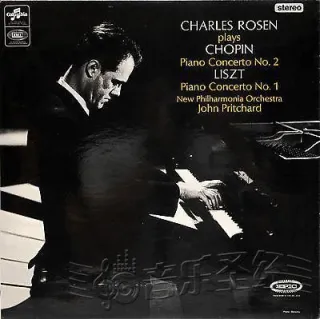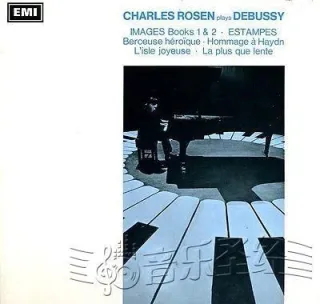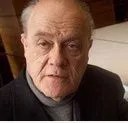
查尔斯·罗森 (Charles Rosen)
查尔斯·罗森
C·Rosen / C·罗森地區美国
類型个人
職業钢琴
藝人資料
Charles Welles Rosen(May 5, 1927– December 9, 2012) was an American pianist and writer on music.He is remembered for his career as a concert pianist, for his recordings, and for his many writings, notable among them the bookThe Classical Style.
Charles Rosen born in New York City on May 5, 1927 to Irwin Rosen, an architect, and Anita Rosen (née Gerber), a semiprofessional actress and amateur pianist.
Charles began his musical studies at age 4 and at age 6 enrolled in the Juilliard School. At age 11 he left Juilliard to study piano with Moriz Rosenthal,and with Rosenthal's wife, Hedwig Kanner. Rosenthal, born in 1862, had been a student of Franz Liszt. Rosenthal's memories of the 19th century in classical music were communicated to his pupil and appear frequently in Rosen's later writings. (For instance, in Critical Entertainments, Rosen offers a memory from Rosenthal concerning how Brahms performed on the piano; specifically that he "rolled" chords upward, starting with the bass note.) Every year from the ages of three to twelve, Rosen heard Josef Hofmann play, and he later suggested that Hofmann had a greater influence on him than Rosenthal.
Rosen's family background was not a wealthy one. The Guardian editor Nicholas Wroe interviewed Rosen in his old age, and reported:
His father had lost his job during the depression and "things were pretty tough for a while". The family moved from Washington Heights to a ho[me] in the then less fashionable Upper West Side, where Rosen still lives. Because money was so short Rosen's parents arranged a contract with the Rosenthals not to pay them for Charles's tuition, but instead to give them 15% of his earnings as a pianist until the age of 21. "As I didn't make my debut in New York until I was 23, it was not a very satisfactory deal. But when I made my first recording I took some money to Hedwig [Kanner] Rosenthal, who was very surprised because she had been teaching me for 13 or 14 years at that stage."
At age 17, Rosen enrolled in Princeton University, where he studied French, and also took courses in mathematics and philosophy. When he graduated in 1947, he was offered a fellowship of $2,000 to continue at Princeton in the French graduate program. While in graduate school he roomed with his fellow student Michael Steinberg, who also went on to become a classical-music critic and renowned scholar in his own right.
Rosen attained his status as a musical scholar with very little classroom training. Although the New Grove Dictionary of Music and Musicians refers to him as a student of the musicologist Oliver Strunk, Rosen never formally studied musicology with Strunk or anyone else. Rosen's extensive knowledge of music appears to have arisen partly from a culturally rich family background, and partly from reading. As Wroe reported:
Through the Rosenthals, Rosen was connected to the New York musical scene. ... [He] says that by the time he went to Princeton, he knew all the music department socially. "So that made me too proud to take a degree in music, which I thought would be too easy. I sound like a snotty bastard, which I might have been, but I really did know more music as an undergraduate than the postgraduate students."
Ivan Hewett suggests that a major temptation of Rosen's 1947 fellowship offer was that it offered him time to practice and to read extensively in the Princeton library.
The year 1951 was a busy one for Rosen: he completed his French Literature Ph.D., gave his first piano recital, and made his first recordings, of works by Martinu and Haydn. His career as a pianist made progress only slowly at first, and he traveled to Paris on a Fulbright scholarship to study the relationship between poetry and music in 16th-century France. In 1953 he moved to the Massachusetts Institute of Technology to teach French. He described this period to Nicholas Wroe:
I suppose I could have stayed on as an academic, but I never intended to do anything but play the piano. The only time I taught was when my playing would only support me for half a year, but I could only get a full-time job. So I taught French at MIT Monday to Wednesday, but Thursday through Sunday I was a pianist. In 1955, after two years there, I got an offer from Columbia Artists Management and so I resigned.
The Columbia offer initiated his successful career as a concert pianist: Rosen appeared in numerous recitals and orchestral engagements around the world. Musicologist Stanley Sadie reviewed his pianism as follows:
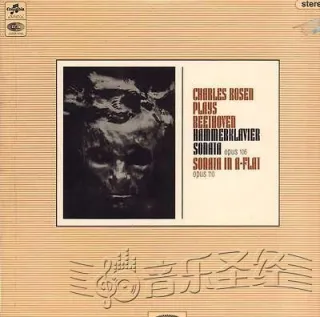
As a pianist, Rosen is intense, severe and intellectual. His playing of Brahms and Schumann has been criticized for lack of expressive warmth; in music earlier and later he has won consistent praise. His performance of Bach's Goldberg Variations is remarkable for its clarity, its vitality and its structural grasp; he has also recorded The Art of Fugue in performances of exceptional lucidity of texture. His Beethoven playing (he specializes in the late sonatas, particularly the Hammerklavier) is notable for its powerful rhythms and its unremitting intellectual force. In Debussy his attention is focussed rather on structural detail than on sensuous beauty. He is a distinguished interpreter of Schoenberg and Webern.
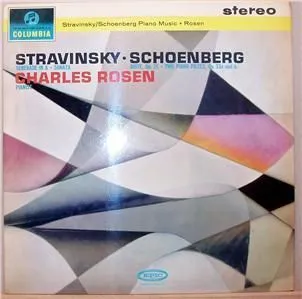
Rosen made a large number of recordings, including recording various 20th century works at the invitation of their composers:
In 1955, he recorded six Scarlatti's sonatas and Mozart's sonata K. 333 on the historical Siena piano (fr).
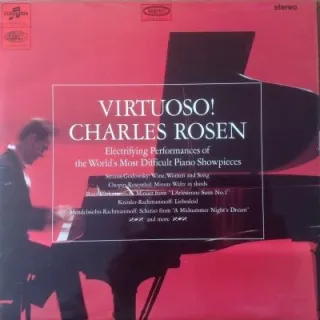
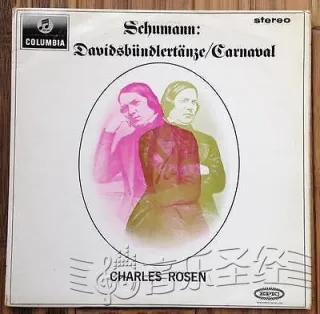
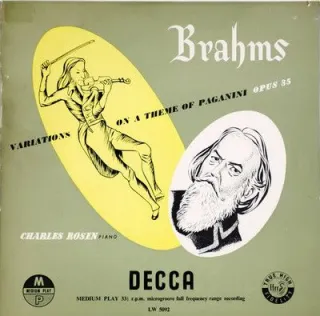
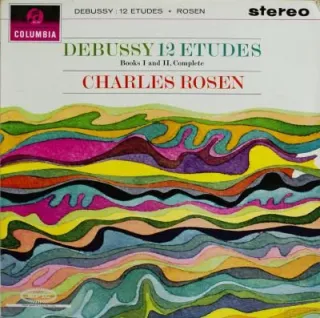
His recordings include earlier literature such as Debussy's Études (1958), Schumann's works for solo piano, Beethoven's late sonatas and Diabelli Variations, and Bach's Art of Fugue and Goldberg Variations.
Rosen's career as an author and scholar began only when he had passed the age of 40. Nicholas Wroe narrates how he started writing:
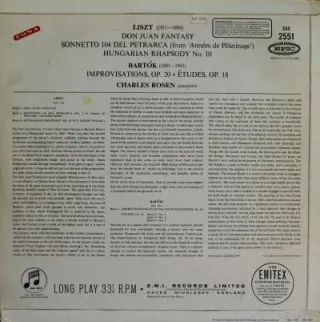
Rosen released his first Chopin recording in 1960. It included one of the late nocturnes, opus 62 no 1 ... Rosen says he wasn't entirely happy with the recording, but he was even more disappointed with the sleeve note, which described the nocturne as "staggering drunken with the odour of flowers". "I had many thoughts about the piece," he says. "That was not one of them. So I started writing the sleeve notes myself. People liked them and after a while a publisher took me to lunch. Before he even offered me a drink he said he would publish whatever I'd like to write. Eventually it led to many books and articles. But to begin with I wrote just to keep nonsense off my record sleeves."
In 1970 Rosen wrote his first column for The New York Review of Books—a scathing review of the then-current edition of the Harvard Dictionary of Music. His association with the magazine continued for the rest of his life. A number of his books collect essays and reviews he wrote for the Review.
In 1971, Rosen published his first and most famous book, The Classical Style. This work was highly successful, winning a National Book Award; and initiated a long series of books.
At various points in his career Rosen took positions as a university professor. His early stint teaching French at MIT is mentioned above. His later teaching was in music, in part-time or visiting positions offered to Rosen after he had achieved fame in his scholarly work. At Harvard University he held the Charles Eliot Norton Chair of Poetics in 1980/1981; the public lectures he gave there served as the basis of The Romantic Generation. He taught one academic quarter per year at the University of Chicago from 1985 to 1996. He taught at Stony Brook University starting 1971, the University of Oxford (1988) and the Royal Northern College of Music.
Even after the scholarly phase of his career had set in, Rosen continued to perform as a pianist for the rest of his life.
He gave his last lecture on April 18, 2012 in the series Music in 21st-Century Society, at the Barry S. Brook Center for Music Research and Documentation of the CUNY Graduate Center.
Rosen died of cancer on December 9, 2012, in New York City, aged 85. His collection of scores and manuscripts was donated to the Music Department of the Graduate Center, City University of New York.
From:https://en.wikipedia.org/wiki/Charles Rosen