Giacomo Puccini 贾科莫·普契尼
贾科莫·普契尼
G·Puccini / G·普契尼地區意大利
類型个人
職業作曲
藝人資料
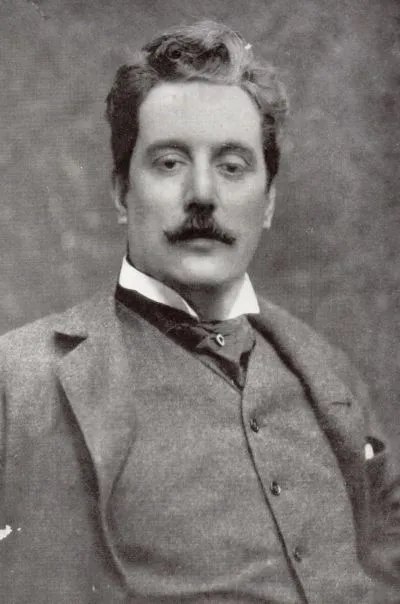
贾科莫·安东尼奥·多米尼科·米歇尔·塞孔多·马利亚·普契尼——意大利歌剧作曲家。1858年12月22日生于卢卡,1924年11月29 日卒于布鲁塞尔。父亲米凯莱从事作曲、演奏、教学活动,在普契尼6岁时就去世了。普契尼童年时并没有显示出特殊的音乐才能或兴趣,由于亲人的希望和母亲的 鼓励,进入卢卡音乐学院,从作曲家C.安杰洛尼学习后,才逐渐显露出音乐才华。16岁参加管风琴比赛获得第1名,19岁任圣马丁教堂合唱队长和管风琴师。 他生活贫困,当邻近城市上演G.威尔迪的《阿依达》时,他徒步往返去听歌剧。这部歌剧使他十分震动,并立志要成为一名歌剧作曲家。
科莫·普契尼出生在意大利托斯卡纳卢卡的一个音乐世家。普契尼的父亲在他5岁时去世,所以他被送到叔叔福图纳托·梅吉(Fortunato Magi)那里来学习音乐,但是福图纳托却认为普契尼是个没有修养且粗俗的学生。后来普契尼成为卢卡教堂的风琴演奏家与唱诗班教师,但是直到观赏了著名的 歌剧作曲家朱塞佩·威尔第的歌剧《阿依达》之后,普契尼才决定当一位歌剧作曲家,而为了欣赏这次歌剧演出,他与朋友徒步18.5英里(30公里)前往比萨。
他10岁开始当唱诗班歌童,14岁任教堂管风琴手。因为普契尼得到了奖学金与一位亲戚的帮助,于是在1880年进入米兰音 乐学校(Milan Conservatory)就读,在浪漫派作曲家蓬基耶利(Amilcare Ponchielli)及巴齐尼(Antonio Bazzini)的指导下学习作曲。在普契尼21岁的这一年,他创作了《安魂曲》(Messa),标志着普契尼家族与卢卡的基督教音乐长久合作之下的颠 峰。
这个作品也隐约透露普契尼成为剧作家的迹象,因为他在舞台上展现出了戏剧化力量。男高音与男低音的独唱者在 咏叹调上具有爆发力的演出,的确是比教堂音乐更加类似歌剧的。因为它所拥有的管弦乐编曲及戏剧般的力量,所以普契尼的《安魂曲》常常被拿来与威尔第的《安魂曲》(Requiem)相题并论。
在音乐学校就读期间,普契尼从丰塔纳(Ferdinando Fontana)那里得到了一个歌剧的剧本,并在1882年参加一次歌剧作曲竞赛。
虽然后来普契尼并没有获胜,不过作品《群妖围舞》后来于1884年在米 兰威尔姆剧院(Teatro Dal Verme)举行公演,而且获得黎柯笛公司(Casa Ricordi)黎柯笛(Giulio Ricordi)的注意。普契尼因为受到黎柯笛的委托,所以第2部歌剧《埃德加》(Edgar)于1889年公演。后来普契尼也与丰塔纳成为终生的好友。
从1891年开始,普契尼大部分的时间都待在位在维亚雷焦的南方的小镇——托瑞德拉古(Torre del Lago)。这是一个距离卢卡15公里、位于第勒尼安海(Tyrrhenian Sea)与马撒秀可里湖(Lake Massaciuccoli)之间的小社区。普契尼在托瑞德拉古承租了一间房子,不过他仍然定期的前往卢卡。在1900年,普契尼买下土地而且在湖上建造 一间别墅,也就是现在的普契尼别墅博物馆(Villa Museo Puccini)。普契尼在这里居住到1921年,因为受到泥煤污染的影响才搬迁到维亚雷娇。在普契尼去世之后,普契尼的别墅变成了普契尼别墅博物馆 (Villa Museo Puccini)。而普契尼则被葬在当地的教堂中,后来他的妻子与儿子也葬在这里。
普契尼别墅博物馆目前为普契尼的孙女西蒙内塔(Simonetta Puccini)所有,目前是开放参观的。
普契尼在托瑞德拉古所创作的歌剧
普契尼的第3部歌剧《玛侬·莱斯科》(MANON LESCAUT)于1893年公演,获得巨大的成功。它连结了普契尼与剧作家雷基·伊利卡(Luigi Illica)及乔赛普·贾科萨(Giuseppe Giacosa)的关系。他们在接下来的3部歌剧共同合作,后来成为普契尼最知名的作品。这3部歌剧分别是:
《波希米亚人》:被认为是普契尼最成功的作品之一,同时也是历史上最传奇性的歌剧之一。
《托斯卡》:实际的描绘出真实生活的不同面向(包括暴力在内),可以说是普契尼第一部带有写实主义色彩的作品。因为它许多重要的特征,所以被认为是历史上最重要作品之一。
《蝴蝶夫人》:一开始被敌视(绝大部分是来自于对手),不过随着几次上演后,现在被认为是普契尼最成功的作品之一。
普契尼在1904年后的创作是越来越稀少,因为对于飙车的怀抱着热情,使得他差点在1903年的一次车祸中身亡。贾科萨于 1906年去世,然后在 1909年爆发一件丑闻,因为妻子艾维拉对于他们的女佣曼佛迪(Doria Manfredi)与普契尼发生关系的不实指控,后来导致该女佣自杀。而艾维拉则遭到曼佛迪的家人控告成功,于是普契尼必须支付赔偿金。普契尼的出版商雷 哥尔第在1912年过世之后,也结束了普契尼剧作家生涯中的多产时期。
不过普契尼还是在1910年完成《西部女郎》,然后在1917年完成了《燕子》(La rondine),这是一部普契尼重新作曲的轻歌剧,但是他发现这与他的风格及才华是格格不入。
《三联剧》(Il Trittico)在1918年于纽约首次公演,这部作品由3个部分所组成。第一个部份是《大衣》(Il Tabarro),属于恐怖的大吉尼奥尔(Grand Guignol)的风格;第二个部分是《修女安洁丽卡》(Suor Angelica),为感人的悲剧;第三个部分则是喜剧《贾尼·斯基基》(Gianni Schicchi)。《贾尼·斯基基》是3个部分最受欢迎的,包括著名的咏叹调:《亲爱的爸爸》。
因为普契尼有抽烟的习惯,所以从1923年底开始抱怨慢性的喉咙痛。因为被诊断出罹患喉癌,所以医生建议他前往比利时的布鲁塞尔进行一种新的实验性放射线治疗。因为普契尼与妻子从不知道癌症是多么严重,所以只有告知他们的儿子。
普契尼在1924年11月29日死于治疗所引发的并发症(因为在手术后无法控制流血状况导致心肌梗死)。他的死讯在《波希 米亚人》上演期间传到了罗马,所以表演立刻终止,管乐队则为这些感到震惊的观众演奏了弗雷德里克·肖邦的《送葬进行曲》(Funeral March)。普契尼在1926年埋葬在米兰,但是他的儿子后来将他的遗体移到托瑞德拉古普契尼别墅内的礼拜堂内。
《图兰朵》是普契尼最后的作品,在普契尼去世时仍未完成,最后的一幕是由弗兰科·阿尔法诺(Franco Alfano)根据普契尼的草稿来完成的。不过弗兰科·阿尔法诺是否完全遵循普契尼的草稿则引起一些质疑。
阿图罗·托斯卡尼尼于 1926年4月指挥《图兰朵》首演时,他选择不演出阿尔法诺完成的部分。当演出进行到普契尼完成的部分结束后,托斯卡尼尼停止管弦乐队的演奏,然后转身对 观众说“这出歌剧到这里就结束了,因为在这个时候这位大师(意指普契尼)已经过世了”(有一些纪录则显示托斯卡尼尼是更有诗意的说:“这位大师在这里放下 了他的笔”)
意大利作曲家贝里奥(Luciano Berio)在2001年时根据原本的手稿完成了《图兰朵》一个新的正式的结局,但是这个结局并不常被演出。后来中国作曲家郝维亚也写了另一个版本的结局,在中国国家大剧院上演。
普契尼在政治上并不活跃,这点与威尔第或华格纳不同。然而,意大利法西斯主义的领导人墨索里尼宣称,普契尼申请加入 意大利国家法西斯党。不过这件事看来是不太可信的,因为并没有纪录或证明普契尼曾经申请加入意大利国家法西斯党。除此之外,如果普契尼真的 曾经这么作过的话,他的好友阿图罗·托斯卡尼尼不太可能与他这么得友好,因为托斯卡尼尼足够来影响普契尼,而且他是个反法西斯主义者。
为了纪念普契尼在歌剧上的成就,意大利的托瑞德拉古在每年7月至8月间都会举行普契尼音乐节。
他是十九世纪末至欧战前真实主义歌剧流派的代表人物之一。这一流派追求题材真实,感情鲜明,戏剧效果惊人而优于浪漫主义作品。普契尼的音乐中吸收话剧式的对话手法,注意不以歌唱阻碍剧情的展开,除直接采用各国民歌外,还善于使用新手法。
普契尼是十九世纪末至二十世纪初“真实主义”歌剧流派的首要人物之一。
摘自:https://www.sin80.com/artist/puccini#bio
Giacomo Antonio Domenico Michele Secondo Maria Puccini ( 22 December 1858 – 29 November 1924) was an Italian composer whose operas are among the important operas played as standards.
Puccini has been called "the greatest composer of Italian opera after Verdi". While his early work was rooted in traditional late-19th-century romantic Italian opera, he successfully developed his work in the realistic verismo style, of which he became one of the leading exponents.
Puccini was born Giacomo Antonio Domenico Michele Secondo Maria Puccini in Lucca in Tuscany, in 1858. He was one of nine children of Michele Puccini and Albina Magi. The Puccini family was established in Lucca as a local musical dynasty by Puccini's great-great grandfather – also named Giacomo (1712–1781). This first Giacomo Puccini was maestro di cappella of the Cattedrale di San Martino in Lucca. He was succeeded in this position by his son, Antonio Puccini, and then by Antonio's son Domenico, and Domenico's son Michele (father of the subject of this article). Each of these men studied music at Bologna, and some took additional musical studies elsewhere. Domenico Puccini studied for a time under Giovanni Paisiello. Each composed music for the church. In addition, Domenico composed several operas, and Michele composed one opera. Puccini's father Michele enjoyed a reputation throughout northern Italy, and his funeral was an occasion of public mourning, at which the then-famed composer Giovanni Pacini conducted a Requiem.
With the Puccini family having occupied the position of maestro di cappella for 124 years (1740–1864) by the time of Michele's death, it was anticipated that Michele's son Giacomo would occupy that position as well when he was old enough. However, when Michele Puccini died in 1864, his son Giacomo was only six years old, and thus not capable of taking over his father's job. As a child, he nevertheless participated in the musical life of the Cattedrale di San Martino, as a member of the boys' choir and later as a substitute organist.
Puccini was given a general education at the seminary of San Michele in Lucca, and then at the seminary of the cathedral.One of Puccini's uncles, Fortunato Magi, supervised his musical education. Puccini got a diploma from the Pacini School of Music in Lucca in 1880, having studied there with his uncle Fortunato, and later with Carlo Angeloni, who had also instructed Alfredo Catalani. A grant from the Italian Queen Margherita, and assistance from another uncle, Nicholas Cerù, provided the funds necessary for Puccini to continue his studies at the Milan Conservatory, where he studied composition with Stefano Ronchetti-Monteviti, Amilcare Ponchielli, and Antonio Bazzini. Puccini studied at the conservatory for three years. In 1880, at the age of 21, Puccini composed his Mass, which marks the culmination of his family's long association with church music in his native Lucca.
There is little doubt today that of all operatic music, Puccini's is the most universally known; more people know the famous arias from La Boh�me, Madame Butterfly and Turandot than any others, with the single possible exception of those from Carmen – a remarkable achievement considering Puccini's early artistic struggles.
Giacomo Puccini (December 22, 1858 – November 29, 1924) was a native of Lucca, born into a family which since the arrival there of a Giacomo Puccini in the 1730s had been involved in the music of the ancient town for five generations. Each generation composed and played the organ for San Martino Cathedral in Lucca. Giacomo was the fifth child of Michele and Albina Puccini, but his father died in 1864 when Giacomo was nearly five years old. Contrary to the monotonous litany of childhood musical prodigies which litter history, Giacomo showed no early interest in music, although everyone in Lucca expected him to. Instead he was a lazy, shiftless boy, poor at schoolwork and apt to play truant.
His mother, however, was convinced of his abilities and procured him a tutor at the Conservatorio Musici. This time he made modest progress, becoming a choirboy at San Martino and playing the organ there from the age of 14. By his seventeenth year he had begun writing small compositions. While still 17, Puccini attended a performance of Giuseppe Verdi's Aïda in Milan; it was this experience which concentrated all his ambitions, convincing him that a career as an opera composer was the only one to consider. For the next four years he studied hard, eventually writing a pleasing Mass in 1860 (later called Messa di Gloria).
Puccini spent the next three years at Milan Conservatoire, where he was taught by Antonio Bazzini and Amilcare Ponchielli, and where he undoubtedly suffered privation due to a severe lack of funds, although this is not enough to explain the extraordinary meanness with money which he showed later in life, even when he was very rich. He submitted as his "passing-out" piece the orchestral Capriccio Sinfonico, an attractive and colorful work which Puccini later cannibalized for operas, specifically Edgar and La Bohme.
Having left the Conservatoire, Puccini had to decide how to make a start in opera. An opportunity presented itself when the kindly Ponchielli drew his attention to a one-act opera prize announced by the publisher Sonzogno and arranged for a librettist by the name of Ferdinando Fontana. Puccini wrote Le Villi in such haste to meet the prize's deadline that the score was virtually unreadable, and this poor exhibit was ignored by the judges. Both Fontana and Ponchielli were convinced of its worth, however, and between them they engaged the sympathetic support of the great Verdi librettist and opera composer, Arriago Boito, as well as the enthusiastic backing of Giullo Ricordi, owner of the Ricordi publishing house. A production was mounted in Milan in May 1884, proving an enormous success, with the Corriere della Sera critic commenting: "We sincerely believe that Puccini may be the composer for whom Italy has been waiting a long time".
His next opera, Edgar though again given Ricordi's enthusiastic backing, just would not come right, its poorly-executed libretto, grand opera pretensions and melodramatic plot failing to inspire Puccini, despite much hard work. Even after its initial failure in 1889, Puccini continued to revise it, determined not to waste five years of effort. But a failure Edgar has remained to this day. It is a measure of Ricordi's good judgment that he never wavered in his support for Puccini, although even he was unnerved by the composer's next choice of subject, the Abbe Prevost's novella Manon Lescaut, particularly in view of the fact that the story had been given successful operatic form by Jules Massenet in his Paris production of Manon in 1884.
Puccini remained unshakeable in his choice, knowing what type of subject most suited his abilities. When it came to establishing an acceptable libretto, Puccini showed that he had learnt from his experiences with Edgar and Le Villi; this time he engaged and dismissed three librettists before finally accepting Ricordi's suggested pairing, Luigi Illica and Giuseppe Giacosa. The result was a quantum leap forward from his previous efforts.
It was premiered in Turin in 1893, receiving the unanimous praise for which Puccini had waited for nearly a decade, and before the year was out it had been successfully staged in St. Petersburg, Rio de Janeiro, Buenos Aires and Munich. In one stroke the royalties enabled Puccini to repay his debts to Ricordi and begin living in his chosen village, Torre del Lago, a few miles outside Lucca, in some degree of style.
The 10 years since Le Villi had seen great changes take place in Puccini's private life: his beloved mother had died in 1884 and shortly afterwards he had eloped with 24-year-old Elvira Gemignani, the wife of a local businessman. Said to have been a beauty when young, Elvira was a woman of little gaiety or humour, and the marriage did not long remain a happy one. Puccini, moreover, was a handsome man with a roving eye, and once he became famous he had endless poorly-concealed affairs.
After Manon came the first opera in the group later known as the "Big Three". La Boh�me, taken from the Henri Murger novel Scenes de la vie de boh�me, was probably brought to Puccini's attention by his fellow-composer Ruggero Leoncavallo, who was working on his own version of the tale. Puccini had a penchant for working on ideas first begun by others, as if their interest in the idea proved its worth.
Needless to say, it became a race to see who could complete their opera first. Puccini, in league with his librettists, Illica and Giacosa, won; their treatment was ready for the Turin premiere in February 1896, conducted by the 28-year-old Arturo Toscanini. While the public was enthusiastic, only one of the critics present found good words to say for it, the rest seeing it as showing "a deplorable decline" from the standards set by Manon Lescaut.
They utterly failed to grasp its essentially different nature, rooted in lyric opera and a charming sense of
the everyday.
The follow-up arrived four years later, in 1900; it was based on a shocking melodrama of the so-called "realism" school of French drama, Tosca by Victorien Sardou, which had been a sensation in Paris, partly due to the presence of Sarah Bernhardt in the lead role. It was written with a minimum of problems with the libretto or the music, and was prepared meticulously for a Rome premiere, but this time the reception was not all that Puccini and Ricordi had hoped for.
Few critics managed to see or hear the advances Puccini had made in the work, or its incredible dynamism, preferring to stress only the tawdriness of the tale and the lack of any redeeming moral sense. In this sense Tosca was a truly modern opera, the closest to verismo which Puccini ever came.
The next subject for an opera took some time to find, even though Puccini was searching assiduously within a month of Tosca's premiere. After considering a good half-dozen ideas, in 1900 Puccini saw the London production of Madam Butterfly by the American playwright David Belasco.
Although unable to understand English, Puccini was profoundly moved by its plot. Once a contract was signed with Belasco, Puccini began the work in earnest, including a painstaking search for background information on Japan and its culture. Work went smoothly until a major row developed between Puccini and Giacosa over whether the opera should be in three acts or two. In a rare theatrical misjudgment, Puccini wanted two: Giacosa three.
The opening night's debacle at La Scala in 1904 was no doubt the result of an organized claque, but with only one interval, the two extra long acts were simply too much for a Milan audience unused to such demands being made on their concentration. At Brescia three months later the opera, now divided into three acts, was a stupendous success. Butterfly remained Puccini's favorite of his operas, and he spent the next few years traveling to far-flung productions to ensure that his wishes were honored by the respective companies.
This was one of the factors contributing to the public's wait of seven years for Puccini's next opera. Another factor was his fruitless search for operatic ideas. The subject of La Fanciulla del West (Girl of the Golden West), was only decided upon in the autumn of 1907, months after a trip with Elvira to New York where he had seen Belasco's play of the same title.
There was a private reason for the hiatus, and it concerned his marriage; Puccini's propensity for affairs and Elvira's raging jealously had led to many quarrels over the years, and the relationship had now deteriorated into one of mutual exasperation. In late 1906 Elvira became convinced that Puccini had been unfaithful with their young maid, Doria Manfredi. Puccini, for once, was innocent, but Elvira began a vicious and systematic persecution of the girl, and in January 1909 Doria committed suicide. The whole village turned against Elvira while Puccini, horrified by the whole affair and disgusted with his wife, packed her off to Milan. Elvira was tried and sentenced to five months in prison. It was only after Puccini made a handsome settlement on the girl's family that the action was dropped. The rift between husband and wife took years to heal, and during the next decade Puccini embarked on a number of passionate and sustained affairs with younger women.
Under these circumstances, it is hardly surprising that La Fanciulla took until August 1910 to complete, or that the new opera, premiered at New York's Metropolitan Opera House with Caruso in the cast, would be a hit-and-miss affair. Though it demonstrated a convincing advance in musical styles for Puccini, it contained a surprising lack of set-piece arias or of sympathetic characters. For once Puccini enjoyed a rapturous first-night reception from the audience, but for the first time since Edgar the welcome was not to sustain Itself over the years to come.
During the following decade Puccini experienced many disappointments and partial successes. His next project, which was finally begun in 1913, was the trio of one-act operas called Il Trittico, made up of Il Tabarro, a bleak and violent piece of social realism; Suor Angelica, a delicate and lyrical tragedy with a suffering heroine; and Gianni Schicchi, a sparkling comedy. The idea for Il Trittico was one which his old publisher, Giulio Ricordi, had fought against for years, but with his death in 1912 and the accession of his son Tito (who had little time for Puccini and his vacillations) as head of the firm, Puccini followed his own muse.
In 1913 Puccini was approached by two impresarios from the Theater an der Wien in Vienna to write 10 numbers for a new operetta, half of them to be sad, half gay, for which he was to be paid a fortune. The plan for La Rondine came together very rapidly, Puccini working hard on the project with his new librettist, Giuseppe Adami, but World War I intervened in 1915, putting Italy and Austria on opposite sides of the conflict. La Rondine was eventually premiered at Monte Carlo. Neither fish nor fowl, the work has never really secured a place on the world's stages, although it contains some glorious melodic moments.
Meanwhile, work on Il Trittico had slowly progressed and in December 1918 the three one-act operas were premiered at the Metropolitan, New York; only Gianni Schicchi received unqualified approval. This pattern was repeated elsewhere, and although for years Puccini violently objected to the three works being parted from each other; when he finally saw a production in Lucca in 1921 he realized that its three hour duration was asking too much of the audience and stopped his objections – with the result that the first two operas virtually disappeared from public sight. In recent years, Il Tabarro at least has come to be recognized for the forward-looking masterpiece of mood and atmosphere which it undoubtedly is.
Now over 60, Puccini was determined to write an opera which was on a higher plane than before and entirely different from all his others. Another long search for a subject led him to Carlo Gozzi's 1761 play, Turandotte. Once Puccini had familiarized himself with the commedia dell'arte ideas of Gozzi and the ersatz Chinese setting, he commissioned a libretto and set to work in the spring of 1920. In many letters written at this time it is clear that he felt he was putting his soul into Turandot, and the work totally absorbed him. But it was delayed by problems with the libretto and Puccini moving house to Viareggio. By March 1924 the opera was complete but the final two scenes, which Puccini, waiting for the right inspiration, shied away from completing. He was not to get the chance: a sore throat and cough which had begun to affect the lifelong smoker in the autumn of 1923 had not receded by the summer of the following year, and although doctors found nothing wrong with him, Puccini suspected the underlying seriousness of the malady. In October, the opera still not finished, he was told that he had throat cancer which was too advanced to be operable. Nevertheless, a treatment was attempted by surgeons in Brussels, but Puccini's heart was not strong enough to withstand the post-operative shock and he died on November 24.
Turandot was given its premiere in April 1926; it had been completed by Franco Alfano, under Toscanini's sometimes irascible supervision. On the first night the music was stopped by the maestro at the point where Puccini's score broke off. After that, the completed version was given. It was a triumphant success, but one the composer would never enjoy.