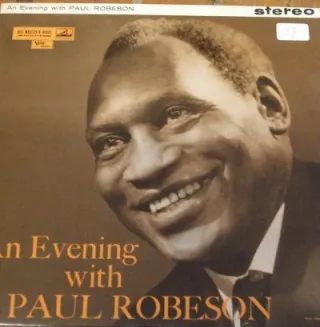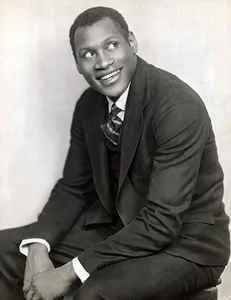
保罗·罗伯逊 (Paul Robeson)
保罗·罗伯逊
P·Robeson / P·罗伯逊類型个人
職業男低音
藝人資料
Paul Leroy Robeson (pronounced /ˈroʊbsən/ ROHB-sən;April 9, 1898– January 23, 1976) was an American bass baritone singer and actor who became involved with the Civil Rights Movement. At Rutgers College, he was an American football player, and then had an international career in singing, as well as acting in theater and movies. He became politically involved in response to the Spanish Civil War, fascism, and social injustices. His advocacy of anti-imperialism, affiliation with communism, and criticism of the United States government caused him to be blacklisted during the McCarthy era.
In 1915 Robeson won an academic scholarship to Rutgers College, where he was twice named a consensus All-American and was the class valedictorian. Almost eighty years later, he was inducted into the College Football Hall of Fame. He received his LL.B. from Columbia Law School, while playing in the National Football League (NFL). At Columbia, he sang and acted in off-campus productions. After graduating, he became a figure in the Harlem Renaissance with performances in The Emperor Jones and All God's Chillun Got Wings.
Between 1925 and 1961, Robeson recorded and released some 276 distinct songs, many of which were recorded several times. The first of these were the spirituals "Steal Away" backed with "Were You There" in 1925. Robeson's recorded repertoire spanned many styles, including Americana, popular standards, classical music, European folk songs, political songs, poetry and spoken excerpts from plays. Robeson's politics did not prevent him from singing some songs which would subsequently be considered[by whom?] to have racist language or sentiment, such as "The Little Pickaninny's Gone to Sleep" (1928) and "Old Folks at Home" (1930).
Robeson first appeared outside the United States in 1928 in the London premiere of Show Boat, settling in London for several years with his wife Essie. Robeson next appeared as Othello in London before gaining international renown as an actor in Show Boat and Sanders of the River. He became increasingly attuned to the sufferings of people of other cultures[citation needed]. He advocated for Republican forces during the Spanish Civil War. He then became active in the Council on African Affairs (CAA).
During World War II, he supported America's war efforts. However, his history of supporting pro-Soviet policies brought scrutiny from the FBI. After the war ended, the CAA was placed on the Attorney General's List of Subversive Organizations and Robeson was investigated during the age of McCarthyism. Due to his decision not to recant his public advocacy of pro-Soviet policies, he was denied a passport by the U.S. State Department, and his income, consequently, plummeted. He moved to Harlem and published a periodical critical of United States policies. His right to travel was eventually restored by the 1958 United States Supreme Court decision, Kent v. Dulles. In the early 1960s he retired and lived the remaining years of his life privately in Philadelphia.
<a href="<a href=" https:="" en.wikipedia.org="" wiki="" '="">https://en.wikipedia.org/wiki/'>https://en.wikipedia.org/wiki/Paul Robeson