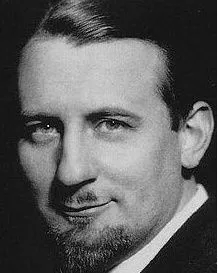
Peter Warlock 彼得·沃洛克
彼得·沃洛克
P·Warlock / P·沃洛克類型个人
職業作曲
藝人資料
Philip Arnold Heseltine(30 October 1894–17 December 1930), known by thepseudonymPeter Warlock, was a Britishcomposerand music critic. The Warlock name, which reflects Heseltine's interest in occult practices, was used for all his published musical works. He is best known as a composer of songs and other vocal music; he also achieved notoriety in his lifetime through his unconventional and often scandalous lifestyle.
As a schoolboy at Eton College, Heseltine met the British composer Frederick Delius, with whom he formed a close friendship. After a failed student career in Oxford and London, Heseltine turned to musical journalism, while developing interests in folk-song and Elizabethan music. His first serious compositions date from around 1915. Following a period of drift and inactivity, a positive and lasting influence on his work arose from his meeting in 1916 with the Dutch composer Bernard van Dieren; he also gained creative impetus from a year spent in Ireland, studying Celtic culture and language. On his return to England in 1918, Heseltine began composing songs in a distinctive, original style, while building a reputation as a combative and controversial music critic. During 1920–21 he edited the music magazine The Sackbut. His most prolific period as a composer came in the 1920s, when he was based first in Wales and later at Eynsford in Kent.
Through his critical writings, published under his own name, Heseltine made a pioneering contribution to the scholarship of early music. In addition, he produced a full-length biography of Delius and wrote, edited, or otherwise assisted the production of several other books and pamphlets. Towards the end of his life, Heseltine became depressed by a loss of his creative inspiration. He died in his London flat of coal gas poisoning in 1930, probably by his own hand.
In the early 20th century the German-influenced 19th-century song-writing traditions generally followed by Hubert Parry, Charles Villiers Stanford, Edward Elgar and Roger Quilter, were in a process of eclipse. For composers such as Ralph Vaughan Williams and George Butterworth, English folk-song became a dominant feature of their work; at the same time, songwriters were seeking to extend their art by moving beyond the piano to develop richer forms of vocal accompaniment. Thus, as Copley observes, at the outset of his career as a composer Heseltine found in song-writing a dynamic ambience, "within which he could express himself, or against which he could react".
By the time Heseltine began composing seriously, around 1915–16, he had started to shake off the overwhelming influence of Delius. He had discovered English folk-song in 1913, his Oxford year, and had begun to study Elizabethan and Jacobean music. In 1916 he came under the spell of van Dieren, whose influence soon exceeded that of Delius and led to a significant development in compositional technique, first evident in the Saudades song cycle of 1916–17. Gray writes that from Van Dieren, Heseltine "learned to purify and organise his harmonic texture ... and the thick, muddy chords which characterised the early songs gave place to clear and vigorous part-writing". "In 1917–18 Heseltine's passion for Celtic culture, stimulated by his stay in Ireland, brought a new element to his music, and in 1921 he discovered Bartók. A late passion was the music of John Dowland, the Elizabethan lutenist, one of whose dances he arranged for brass band. These constituent parts contributed to the individual style of Heseltine's music.Gray summarised this style thus;
They [the differing elements] are fused together in a curiously personal way: the separate ingredients can be analysed and defined, but not the ultimate product, which is not Dowland plus van Dieren or Elizabethan plus modern, but simply something wholly individual and unanalysable—Peter Warlock. No one else could have written it.
Apart from those within his circle, Heseltine drew inspiration from other composers whose work he respected: Franz Liszt, Gabriel Fauré, and Claude Debussy. He had, however, a particular dislike for the works of his fellow song-writer Hugo Wolf. Heseltine's songs demonstrate moods of both darkness and warm good humour, a dichotomy that helped to fuel the idea of a split Warlock/Heseltine personality. This theory was rejected by the composer's friends and associates, who tended to see the division in terms of "Philip drunk or Philip sober".
In a summary of the Warlock oeuvre, Copley asserts that Heseltine was a natural melodist in the Schubert mould: "With very few exceptions his melodies will stand on their own ... they can be sung by themselves with no accompaniment, as complete and satisfing as folk-songs". Copley identifies certain characteristic motifs or "fingerprints", which recur throughout the works and which are used to depict differences of mood and atmosphere: anguish, resignation but also warmth, tenderness and amorous dalliance. The music critic Ernest Bradbury comments that Heseltine's songs "serve both singer and poet, the one in their memorably tuneful vocal lines, the other in a scrupulous regard for correct accentuation free from any suggestion of pedantry".
In musical parlance Heseltine was a miniaturist, a title which he was happy to accept in disregard of the sometimes derogatory implications of the label: "I have neither the impulse nor the ability to erect monuments before which a new generation will bow down". He was almost entirely self-taught, avoiding through his lack of a formal conservatory training the "teutonic shadow"—the influence of the German masters. To the charge that his technique was "amateurish", he responded by arguing that a composer should express himself in his own terms, not by "string[ing] together a number of tags and clichés culled from the work of others". His compositions were themselves part of a learning process; The Curlew song cycle originated in 1915 with the setting of a Yeats poem, but did not reach completion until 1922. Brian Collins characterises this work as "a chronicle of [the composer's] progress and development".
Heseltine's music was generally well received by public and critics. The first Warlock compositions to attract critical attention were three of the Dublin songs which Rogers published in 1918. William Child in The Musical Times thought these "first rate", and singled out "If Ever I Saw" as having particular distinction. In 1922, in the same magazine, the short song cycle Mr Belloc's Fancy was likewise praised, especially "Warlock's rattling good tunes and appropriately full-blooded accompaniment". Ralph Vaughan Williams was delighted with the reception accorded to the Three Carols, when he conducted the Bach Choir at the Queen's Hall in December 1923. Early in 1925 the BBC broadcast a performance of the Serenade for string orchestra written to honour Delius, a sign, says Smith, that the music establishment was beginning to take Warlock seriously. Heseltine himself noted the warmth of the Prom audience's reaction to his conducting of the Capriol Suite in 1929: "I was recalled four times".
After Heseltine's death, assessments of his musical stature were generous. Newman considered some of Heseltine's choral compositions "among the finest music written for massed voices by a modern Englishman." Constant Lambert hailed him as "one of the greatest song-writers that music has ever known", a view echoed by Copley. In a tribute published in The Musical Times, van Dieren referred to Heseltine's music as "a national treasure" that would long survive all that was currently being said or written about it. In subsequent years his standing as a composer diminished; Brian Collins records how public perceptions of Warlock were distorted by the scandalous reports of his private life, so that his musical importance in the inter-war years became obscured. However, when the Peter Warlock Society was created in 1963, interest in his music began to increase. Collins acknowledges that the Warlock output includes much that can be dismissed as mere programme-fillers and encore items, but these do not detract from numerous works of the highest quality, "frequently thrilling and passionate and, occasionally, innovative to the point of being revolutionary".
From:https://en.wikipedia.org/wiki/Peter Warlock