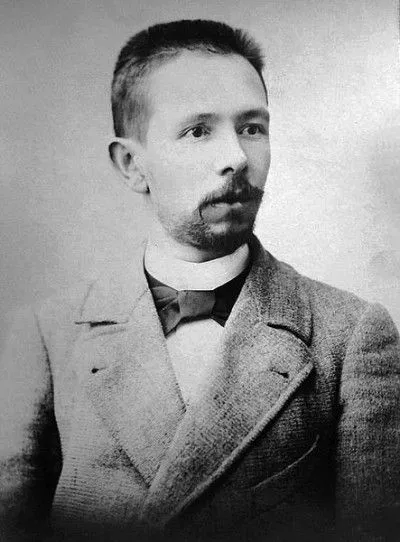
Vasily Sergeyevich Kalinnikov 瓦西里·谢尔盖耶维奇·可林尼科夫
瓦西里·谢尔盖耶维奇·可林尼科夫
V·S·Kalinnikov / V·S·可林尼科夫地區俄罗斯
類型个人
職業作曲
藝人資料
俄罗斯作曲家。出生于奥廖尔一个贫困的家庭,父亲是一个警察。14岁时卡林尼科夫成为了一个合唱团的指挥。之后进入莫斯科音乐学院,但因学费问题辍学。后学习大管演奏以维生。1892年得柴可夫斯基推荐担任剧院指挥,但由于肺结核加重,不得不辞职到克里米亚休养。他选择居住在雅尔塔,在那里他创作了他大部分的作品,1901年由于肺结核在雅尔塔去世,年仅35岁。感谢拉赫玛尼诺夫的帮助,出版商在卡林尼科夫生前出版了他的几首歌曲,而他的2部交响曲在他生前也得到了演出的机会。他的代表作是他的“第1交响曲”。
Vasily Sergeyevich Kalinnikov (Russian: Васи́лий Серге́евич Кали́нников; January 13[O.S. January 1]1866 Oryol Governorate– January 11, 1901 [O.S. December 29, 1900], Yalta) was a Russian composer of two symphonies, several additional orchestral works and numerous songs, all of them imbued with characteristics of folksong. His symphonies, particularly the First, were frequently performed in the early 20th century.
His younger brother Viktor Kalinnikov (1870–1927) was also a composer, mainly of choral music.
Kalinnikov was a policeman's son. He studied at the seminary at Oryol, becoming director of the choir there at fourteen. Later he went to the Moscow Conservatory but could not afford the tuition fees. On a scholarship he went to the Moscow Philharmonic Society School, where he received bassoon and composition lessons from Alexander Ilyinsky. He played bassoon, timpani and violin in theater orchestras and supplemented his income working as a music copyist.
In 1892, Pyotr Ilyich Tchaikovsky recommended Kalinnikov to be the director of the Maly Theater, and later that same year to the Moscow Italian Theater. However, due to his worsening tuberculosis, Kalinnikov had to resign from his theater appointments and move to the warmer southern clime of the Crimea. He lived at Yalta for the rest of his life, and it was there that he wrote the main part of his music, including his two symphonies and the incidental music for Alexey Tolstoy's Tsar Boris. Exhausted, he died of tuberculosis on January 11, 1901, just before his 35th birthday.
Thanks to Sergei Rachmaninoff's help, Tchaikovsky's publisher P. Jurgenson bought three Kalinnikov songs for 120 rubles, and later the Symphony No. 2 in A major. The Symphony No. 1 in G minor, which uses some cyclic principles, was performed in Berlin, Vienna and Moscow during his lifetime, but not published until after his death, so Jurgenson increased the fees he would have paid Kalinnikov, and paid them to his widow. He was also survived by a brother, Viktor, who composed choral music and taught at the Moscow Philharmonic Society School.
His reputation was established with his First Symphony, written between 1894 and 1895, which had great success when Vinogradsky conducted it at a Russian Musical Society concert in Kiev on 20 February 1897. Further performances swiftly followed, in Moscow, Vienna, Berlin, and Paris (Spencer 2001).
In Russia his First Symphony remains in the repertory, and his place in musical history there is secure (Spencer 2001). On November 7, 1943, Arturo Toscanini conducted the NBC Symphony Orchestra in a rare broadcast performance of the First Symphony; although the performance was recorded, it was never commercially released by RCA Victor, but has recently appeared on Relief CR 1886 (Anon. & n.d.(b), 15) and on CD Testament SBT21404 (Anon. 2006). A wind band transcription of the finale of the First Symphony by Glenn Cliffe Bainum has also become a staple of the band repertoire (Anon. 2015).