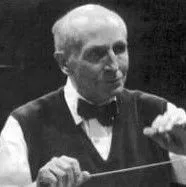
Carl Schuricht 卡尔·舒里希特
卡尔·舒里希特
C·Schuricht / C·舒里希特地區德国
類型个人
職業指挥
藝人資料
卡尔·舒里希特(Carl·Schuricht 1880.7.3–1967.1.7),6岁开始学习小提琴和钢琴,11岁他尝试作曲,15岁的他首次指挥乐队;1901年任美因兹市立剧院担任合唱指挥,后就读于柏林音乐高校;1912年任威斯巴登市立交响乐团音乐指导,1933年他被任命为柏林爱乐乐合唱团指挥,此后相继指挥维也纳爱乐乐团、法兰克福广播交响乐团、德累斯顿爱乐乐团,1944年他离开德国。50年代,他在欧美等国巡回演出,相继指挥波士顿交响乐团、维也纳爱乐乐团,出席萨尔斯堡音乐会,还作客柏林和伦敦;在1960年被维也纳爱乐乐团授予荣誉会员;1967年在瑞士去世。
Carl Adolph Schuricht(German:[ˈʃuːʁɪçt]; 3 July 1880– 7 January 1967) was aGermanconductor.
Schuricht was born in Danzig (Gdańsk), German Empire; his father's family had been respected organ-builders. His mother, Amanda Wusinowska, a widow soon after her marriage (Carl's father Carl Conrad Schuricht drowned in the Baltic Sea while saving a friend, three weeks before he was born), brought up her son alone. His childhood was surrounded by music - "every Sunday in summer we used to hire three large open carriages and go out into the country. After the picnic we would join in singing choral works by Bach, Handel and Mendelssohn." He showed a talent for music at an early age, studying piano and violin from the age of six. By eleven he was composing, and continued his academic and musical studies when his mother moved to Berlin, then to Wiesbaden.
At 20 he obtained the post of Korrepetitor at the Stadttheater in Mainz and two years later won the Kuczynski Foundation prize for composition and a Felix von Mendelssohn scholarship. He then returned to Berlin to study piano under Ernst Rudorff and composition with Engelbert Humperdinck, later working under Max Reger in Leipzig, publishing chamber pieces, sonatas and lieder. Attracted by the profession of conductor he undertook tours in Germany conducting operettas, operas, choral societies and symphony concerts. During this time he had the chance to watch at rehearsal and in concert such figures as Arthur Nikisch, Felix Weingartner, Ernst von Schuch, Felix Mottl, Hans Richter, Karl Muck and Gustav Mahler.
On 24 May 1906 he heard Frederick Delius's Sea Drift in Essen with the composer present, and promised to Delius that when he had his own orchestra he would conduct it himself, which he did in Frankfurt with Delius again in the audience. More important was perhaps that at the same Festival in 1906 he heard the premiere of Mahler's Sixth Symphony, conducted by the composer. In 1909 he succeeded Siegfried Ochs as director of the Rühlscher Oratorienverein in Frankfurt-am-Main and at 40 was appointed musical director of the municipal orchestra in Wiesbaden; festivals of modern music (Richard Strauss, Reger, Mahler, Delius and Arnold Schoenberg) made Wiesbaden an internationally renowned centre for music. Schuricht said of this time "The German public was no more avid than any other for the novelties which I wanted to give it. I have to prepare it for them gently, convince without bludgeoning, cajole and seduce. I managed this by prefacing concerts of modern music by lectures, which I illustrated with extracts played by myself at the piano or by the orchestra."
His career was not that of a star but he was loved both by the orchestra members and audience. As music director at Wiesbaden (1920-1944) he arranged the first German "Gustav Mahler-Festival" in April 1921, conducting Mahler's symphonies Nos. 2, 3, 5, 6, 7, and "Das Lied von der Erde" (cf. Signale für die musikalische Welt, No. 14, 6 April 1921, p. 384), and a week later the Berlin Philharmonic invited him to Berlin, where he on 2 May conducted Mahler's Sixth symphony. Mahler's works were very popular in Germany, Holland, and Austria during the 1920s but they were eventually banned under the Nazis between 1933 and 1945, owing to the composer's Jewish background. Schuricht continued to conduct Mahler outside Germany. On 5 October 1939, during the Phoney War, a performance of his with the Amsterdam Concertgebouw Orchestra of Mahler's Das Lied von der Erde was disrupted by a woman heckler who called out "Deutschland über alles, Herr Schuricht". The performance is available on a CD. Schuricht was the first recipient of the Gold Medal of the Internationale Gustav Mahler-Gesellschaft in Vienna in 1958. Schuricht worked at the Hague/Scheveningen Festival from 1930–39 and was guest conductor with the Dresden Philharmonic from 1942 to 1944. He was expected to take over as director of the orchestra from 1 October 1944, but escalation of the war meant that the orchestra was closed down and Schuricht himself received a warning that he was about to be arrested, and he fled to Switzerland. He settled in Zürich where he married Maria Martha Banz and worked with l'Orchestre de la Suisse Romande.
During the late 1940s and 1950s Schuricht conducted throughout Switzerland, at the re-opening of the Salzburg Festival in 1946, in Paris, and at the festivals of Holland, Lucerne, Aix-en-Provence and Montreux. He regularly conducted the South German Radio Symphony Orchestra from 1950 to 1966. When the Vienna Philharmonic made their first tour to the USA in 1956, Schuricht replaced Erich Kleiber, sharing the conducting during the six weeks with André Cluytens.
He died at the age of 86 in his home at Corseaux-sur-Vevey, Switzerland, and was buried in Wiesbaden, as an honorary citizen of that city.
From:https://en.wikipedia.org/wiki/Carl Schuricht