范吉利斯 (Vangelis)
范吉利斯
V· / V·范吉利斯地區希腊
類型个人
職業作曲、钢琴
藝人資料
范吉利斯(Vangelis)是一位伟大的希腊音乐家,集创作、演奏和音乐制作于一身,一个真正的全才。被人们称为现代的瓦格纳(Richard Wagner)。他的许多史诗般的电子音乐作品和电影配乐深得乐迷们的钟爱。范吉利斯开创了电子音乐与电影配乐的崭新前景,奠定了所谓未来太空音乐的发展,可谓居功至伟。
Evángelos Odysséas Papathanassíou(born 29 March 1943), best known professionally as Vangelis(/væŋˈɡɛlɪs/),is a Greek composer of electronic, progressive, ambient, jazz, and orchestral music.He is best known for his Academy Award–winning score for the film Chariots of Fire, composing scores for the films Blade Runner, Missing, Antarctica, 1492: Conquest of Paradise, and Alexander, and the use of his music in the PBS documentary Cosmos: A Personal Voyage by Carl Sagan.
Vangelis began his professional musical career working with several popular bands of the 1960s such as the Forminx and Aphrodite's Child, with the latter's album 666 going on to be recognized as a psychedelic classic. Throughout the 1970s, Vangelis composed music scores for several animal documentaries, including L'Apocalypse des Animaux, La Fête sauvage and Opéra sauvage; the success of these scores brought him into the film scoring mainstream. In the early 1980s, Vangelis formed a musical partnership with Jon Anderson, the lead singer of progressive rock band Yes, and the duo went on to release several albums together as Jon & Vangelis.
In 1981, he composed the score for the Oscar-winning film Chariots of Fire, for which he won an Academy Award for Best Original Score. The soundtrack's single, the film's "Titles" theme, also reached the top of the American Billboard Hot 100 chart and was used as the background music at the London 2012 Olympics winners' medal presentation ceremonies. Vangelis also received acclaim for his synthesizer-based soundtrack for the 1982 film Blade Runner.
Having had a career in music spanning over 50 years and having composed and performed more than 50 albums, Vangelis is considered to be one of the most important figures in the history of electronic music.
Vangelis was born 29 March 1943, in Agria, near Volos, Greece. Largely a self-taught musician, he reportedly began composing at the age of three. His earliest memories include playing piano, percussion, and music of his own device. Throughout his career, Vangelis did not have substantial knowledge of reading or writing musical notation. He rebuffed his parents' attempts to supplement his experimentation with formal training. Vangelis has called himself fortunate to not attend music school, which he considers a creative impediment. He studied painting, an art he still practices, at the Athens School of Fine Arts.[citation needed] Vangelis said in an interview with Life, when asked about his lack of ability to read music:
When the teachers asked me to play something, I would pretend that I was reading it and play from memory. I didn't fool them, but I didn't care.
When Vangelis was twelve years old he became interested in jazz music, and with the social movement to rock and roll. At fifteen years old he started to form early school bands, not to cover other musicians, but to have fun, resulting in the early 1960s being one of the founders of pop rock group The Forminx (or the Formynx), which became popular in Greece. Based in Athens, the five-piece band played a mixture of cover versions and their own material, the latter written mostly by Vangelis (with lyrics by DJ and record producer Nico Mastorakis) but still sung in English. The Forminx released nine hit singles and a Christmas EP before disbanding in 1966 at the peak of their success. A film being made about them at the time, which was initially directed by Theo Angelopoulos, was never fully completed, and the songs, composed for the movie, were never released. Vangelis spent the next two years mostly studio-bound, writing and producing for other Greek artists.
Around the time of the student riots in 1968, Vangelis founded progressive rock band Aphrodite's Child together with Demis Roussos, Loukas Sideras, and Anargyros "Silver" Koulouris. After an unsuccessful attempt to enter the UK, they found a home in Paris where they recorded their first single, a hit across much of Europe called "Rain and Tears". Other singles followed, including two albums, which, in total, sold over 20 million copies. The record sales led the record company to request a third album, and Vangelis went on to conceive the double-album 666, based on Revelation, the last book in the Bible. It is often listed as one of the best progressive rock albums. One of the many remarkable features of this album is Irene Papas's guest participation (vocal on "Infinity"). Tensions between members during the recording of 666 eventually caused the split of the band in 1971, but the album was still released in 1972. Despite the split, Vangelis has since produced several albums and singles for Demis Roussos, who, in turn, contributed vocals to the Blade Runner soundtrack. He often recalls on music industry:
I moved into the record industry. I was under the impression that in order to be alive and to be able to create what I had in mind I had to become successful. I realised that success and pure creativity are not very compatible... Instead of being able to move forward freely and do what you really wish, you find yourself stuck and obliged to repeat yourself and your previous success.
While still in Aphrodite's Child, Vangelis had already been involved in other projects. In the 1960s he scored music for three Greek films My Brother, the Traffic Policeman (1963) directed by Filippos Fylaktos, 5,000 Lies (1966) by Giorgos Konstantinou, To Prosopo tis Medousas (1967) by Nikos Koundouros. In 1970 composed the score for Sex-Power directed by Henry Chapier, as well again for Salut, Jerusalem (1972) and Amore (1974).
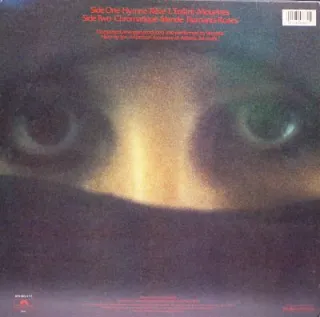
In 1971, some jam sessions with a group of musicians in London had resulted in two albums' worth of material, unofficially released without Vangelis' permission in 1978, titled Hypothesis and The Dragon. Vangelis succeeded in taking legal action to have them withdrawn. A more successful project was his scoring of wildlife documentary films in the early 1970s made by French filmmaker Frédéric Rossif. The first soundtrack L'Apocalypse des animaux was released in 1973. In 1972, the student riots of 1968 provided the inspiration for an album titled Fais que ton rêve soit plus long que la nuit (Make Your Dream Last Longer Than the Night), comprising musical passages mixed with news snippets and protest songs; some lyrics were based on graffiti daubed on walls during the riots. He also did music for the 1973 Henry Chapier film Amore.
In 1973 Vangelis' solo career began in earnest. His second solo album was Earth. It was a percussive-orientated album with Byzantine undertones. It featured a group of musicians including ex-Aphrodite's Child guitarist Silver Koulouris and also vocalist and songwriter Robert Fitoussi (better known as F.R. David of "Words" fame). This line-up, later briefly going out under the name "Odyssey", released a single in 1974 titled "Who", but that was Vangelis' last involvement with them. Later in 1974, Vangelis was widely tipped to join another prog-rock band, Yes, following the departure of Rick Wakeman. After a couple of weeks of rehearsals Vangelis wavered on the option of joining Yes, and the band had to detour and hire Swiss keyboard player Patrick Moraz instead, who later joined the Moody Blues. Vangelis did, however, become friends with Yes' lead vocalist Jon Anderson, and later worked with him on several occasions, including as the duo Jon & Vangelis.
After moving to London in 1975, Vangelis signed with RCA Records, set up his own studio, Nemo Studios, and began recording a string of electronic albums, such as Heaven and Hell (1975), Albedo 0.39 (1976), Spiral (1977), Beaubourg (1978), and China (1979). The Heaven and Hell was premiered at The Royal Albert Hall. Each of the albums had special thematic inspiration; Heaven and Hell the homonymous mythological places, Albedo 0.39 the universe, Spiral the Tao philosophy, Beaubourg the visit to the Centre Georges Pompidou, while China the Chinese cultural and musical traditions.
In 1977 was re-released (originally released in 1975) the film score of Do You Hear the Dogs Barking? directed by François Reichenbach.
In 1976 was released the second soundtrack for Rossif animal documentary, La Fête sauvage, which combined African rhythms with Western music In 1979 was released the third score album for Rossif, Opéra sauvage. Almost as well known as L'Apocalypse des animaux, the resulting soundtrack would bring him to the attention of some of the world's top filmmakers. The music itself would be re-used in other films (most notably the track "L'Enfant" in The Year of Living Dangerously (1982) by Peter Weir; the melody of same (in marching band format) can also be heard at the beginning of the 1924 Summer Olympics opening ceremonies scene in the film Chariots of Fire and television commercials (the track "Hymne", used in Barilla pasta commercials in Italy and Ernest & Julio Gallo wine ads in the US). They again collaborated for Sauvage et Beau (1984), De Nuremburg à Nuremburg (1989).
In 1979 was released album Odes, which included Greek folk songs performed by Vangelis and actress Irene Papas. It was instant success in Greece. It was followed by second collaboration album Rapsodies in 1986.
In the 1980s were released five solo albums; the experimental and satirical See You Later (1980) included "Memories of Green" which featured in the upcoming 1982 film Blade Runner; Soil Festivities was thematically inspired by the interaction between nature and its microscopic living creatures;[ Invisible Connections (1985) by the world of elementary particles invisible to the naked eye; Mask (1985) by the theme of the mask, an obsolete artefact which was used in ancient times for concealment or amusement; and Direct (1988), the first album to be recorded in the post-Nemo Studios era.
In the 1990s were also released five solo albums; The City (1990) was recorded during his stay in Rome in 1989, and reflected a day of bustling city life, from dawn until dusk; Voices (1995) featured sensual songs filled with nocturnal orchestrations; Oceanic (1996) thematically explored the mystery of underwater worlds and sea sailing; two classical albums about El Greco - Foros Timis Ston Greco (1995), which had limited release, and El Greco (1998), which was an expansion of the former.
For an artist of his stature, very little is known about Vangelis' personal life and he rarely gives official interviews to journalists. However, in a 2005 interview with The Daily Telegraph, Vangelis talked openly about various parts of his life. He stated in the interview that he was "never interested" in the "decadent lifestyle" of his band days, choosing not to use alcohol or other drugs. At the time of the Telegraph interview, Vangelis was involved in his third long-term relationship. When asked why he had not had children, Vangelis replied:
…Because of the amount of travelling I do and the nonsense of the music business, I couldn't take care of a child in the way I think it should be taken care of.
It is not publicly known where Vangelis generally resides; he has stated that he "travels around", rather than settling down in one specific place or country for long periods of time. As a hobby, Vangelis enjoys painting; his first art exhibition of 70 paintings was held at Almudin in Valencia, Spain in 2003 and then toured South America until the end of 2004.
Excerpts from other interviews mention that Vangelis has been married twice before. In a 1976 interview with Dutch music magazine Oor, the author wrote that Vangelis had a wife named Veronique Skawinska, a photographer who had done some album art work for Vangelis. An interview in 1982 with Backstage music magazine suggests that Vangelis had previously been married to a singer named Vana Verouti, who had performed vocals on some of his records, performing for the first time with him on La Fête sauvage and later on Heaven and Hell.
From:<a href="<a href=" https:="" en.wikipedia.org="" wiki="" '="">https://en.wikipedia.org/wiki/'>https://en.wikipedia.org/wiki/Vangelis