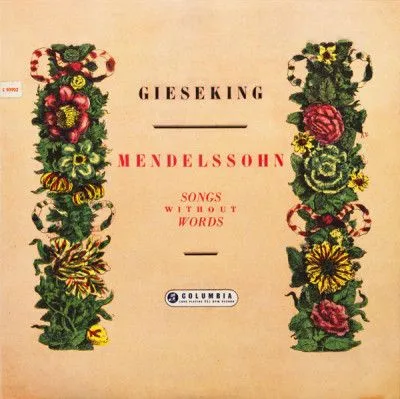
Walter Gieseking 瓦尔特·吉泽金
瓦尔特·吉泽金
W·Gieseking / W·吉泽金地區德国
類型个人
職業作曲、钢琴、指挥
藝人資料
简介Biography
瓦尔特·吉泽金(WalterGieseking,1895——1956),又译季雪金,法国钢琴家。1895年11月5日生于里昂,1956年10月26日卒于伦敦。1911年进汉诺威音乐学院从K·莱默尔学钢琴。1915年在汉诺威连续举行6次独奏会,演奏L.van贝多芬的32首钢琴奏鸣曲。第一次世界大战时在德军中服役,战后在欧洲各大城市旅行演奏。1926年赴美国演出,以后常在欧美各国巡回演奏。1949年有人告发他在第二次世界大战期间曾与纳粹政权合作,因而撤销了当年在美国卡内基音乐厅的演奏会。后经调查澄清,1953年重登美国乐坛。20年代吉泽金以演奏勋伯格、普菲茨纳、欣德米特等现代作曲家的作品著称,后来尤以演奏古典派、浪漫派和印象派作曲家的作品见长。他的演奏曲目极广,包括巴赫、莫扎特、贝多芬、舒伯特、肖邦、舒曼、德彪西、拉威尔、普罗科菲耶夫等作曲家的作品。他是德彪西和拉威尔作品的权威诠释者。细致的指触、清晰而透明的音色和善于运用踏板是他的演奏特色。他录制了很多唱片,尤以贝多芬的钢琴协奏曲和德彪西、拉韦尔的作品最为精采。著有自传《我就这样成为钢琴家》。
吉泽金演奏贝多芬音乐时喜欢加快速度,指挥安塔尔·多拉迪也是如此。他们于1950年5月24日在Titania Palast与RIAS(Radio in American Sector)交响乐团合作演奏的贝多芬《第四钢琴协奏曲》速度快得像要狂欢,给人的感觉似乎不可能再快了。第一乐章中,圆号的演奏不够稳定,整个乐队也有些过火,但钢琴的演奏非常亮丽。还有观众的咳嗽声。
摘自:https://www.sin80.com/artist/walter-gieseking
Walter Wilhelm Gieseking(5 November 1895 – 26 October 1956) was a French-born Germanpianistandcomposer.
Born in Lyon, France, the son of a German doctor and lepidopterist, Gieseking first started playing the piano at the age of four, but without formal instruction. His family travelled frequently and he was privately educated.
From 1911 to early 1916, he studied at the Hanover Conservatory. There his mentor was the director Karl Leimer, with whom he later co-authored a piano method. He made his first appearance as a concert pianist in 1915, but was conscripted in 1916 and spent the remainder of World War I as a regimental bandsman. His first London piano recital took place in 1923, establishing an exceptional and lasting reputation.
During World War II Gieseking continued to reside in Germany, while continuing to concertize in Europe, and was accused of having collaborated with the Nazi Party. He was criticized for this by pianists Vladimir Horowitz, who, in the book Evenings with Horowitz, calls Gieseking a "supporter of the Nazi," and by Arthur Rubinstein who recounted in his book My Many Years a conversation with Gieseking in which alleges he said "I am a committed Nazi. Hitler is saving our country." Gieseking performed in front of Nazi cultural organizations such as the NS Kulturegemeinde and "expressed a desire to play for the Führer". Along with a number of other German artists, Gieseking was blacklisted during the initial postwar period. By January 1947, however, he had been cleared by the U.S. military government, enabling him to resume his career although his U.S. tour scheduled for January 1949 was cancelled owing to protests by organizations such as the Jewish Anti-Defamation League and the American Veterans Committee. Although there had been other protests (in Australia and Peru, for example), his 1949 American tour was the only group of concerts actually cancelled due to the outcry. He continued to play in many other countries, and in 1953 he finally returned to the United States. His concert in Carnegie Hall was sold out and well received, and he was more popular than ever.
Because of his gifts of a natural technique, perfect pitch, and abnormally acute faculty for memorization, Gieseking was able to master unfamiliar repertoire with relatively little practice. From his early instruction in the Leimer method, he usually studied new pieces away from the piano. It became well-known to the public, for instance, that he often committed new works to memory while traveling by train, ship or plane. Sometimes, according to Harold C. Schonberg's book The Great Pianists(1963), he could even learn an entire concerto by heart in one day.
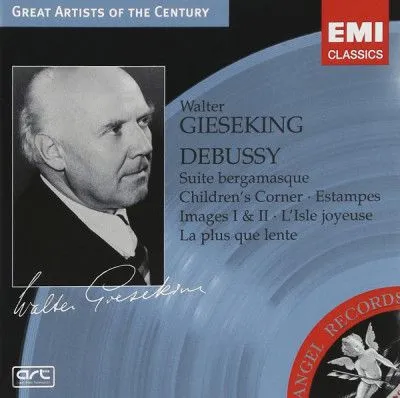
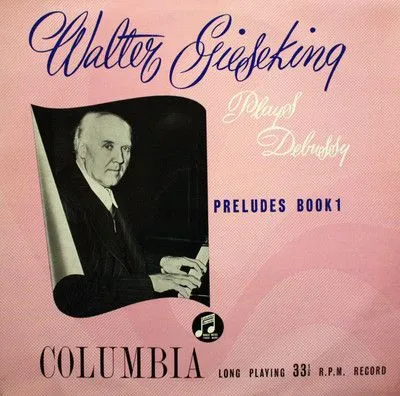
Gieseking had a very wide repertoire, ranging from various pieces by Bach and the core works by Beethoven to the concertos of Rachmaninoff and more modern works by composers such as Busoni, Hindemith, Schoenberg and the lesser-known Italian Petrassi. He gave the premiere of Pfitzner's Piano Concerto in 1923. Today, though, he is particularly remembered for his recordings of the complete piano works of Wolfgang Amadeus Mozart and the two French impressionist masters Claude Debussyand Maurice Ravel, virtually all of whose solo piano music he recorded on LP for EMI in the early 1950s (the Mozart and Debussy sets have recently been re-released on CD), after recording much of it for Columbia in the 1930s and 1940s, some of which have also been re-released on CD.
Gieseking's 1945 performance of Beethoven's "Emperor" Concerto, in which anti-aircraft fire is audible, is one of the earliest stereo recordings, following a rendition of the same work in 1934 for Columbia, with Bruno Walter conducting the Vienna Philharmonic. In December, 1955, Gieseking suffered head injuries in a bus accident near Stuttgart, Germany, in which his wife was killed.
His last recording project was the complete cycle of Beethoven's Piano Sonatas. Gieseking suddenly fell ill in London, however, while recording Beethoven's "Pastoral" Sonata in D Piano Sonata No. 15 for HMV. He had completed the first three movements and, the following day, was due to record the rondo finale but died a few days later of postoperative complications for the relief of pancreatitis. HMV released the unfinished recording, and since then broadcast recordings of Gieseking playing all of Beethoven's Piano Sonatas (with the exception of Op. 54, which he never recorded) have been issued. Although some of his performances, particularly live, could be marred by wrong notes, Gieseking's best performances, as in studio recording sessions, were virtually flawless.
Parallel to Gieseking's work as a performing artist he was also a composer, but even in his lifetime his compositions were hardly known, and he made no attempt to give them publicity. A few of them have recently been recorded on CD.
As Gieseking's father had earned a living as a lepidopterist, Gieseking also devoted much time to the collecting of butterflies and moths throughout his life. His private collection can be seen in the Natural History Collection of the Museum Wiesbaden.