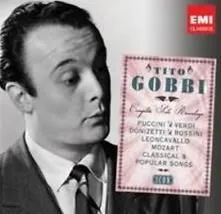
Tito Gobbi 蒂托·戈比
蒂托·戈比
T·Gobbi / T·戈比地区意大利
类型个人
职业男中音
艺人资料
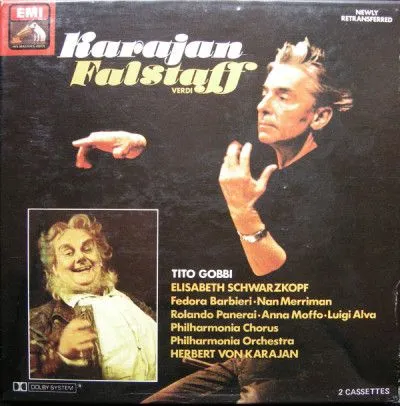
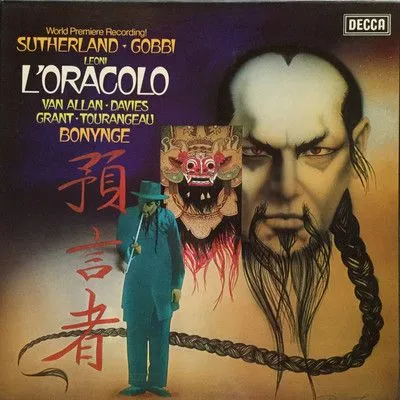
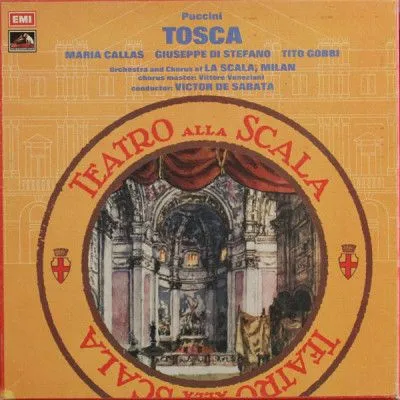
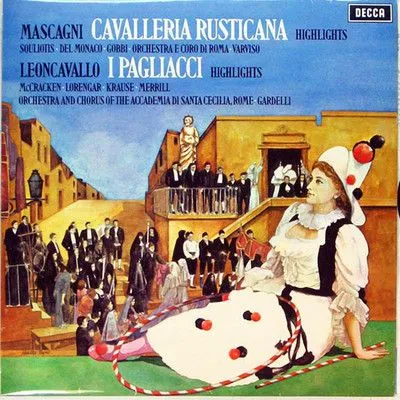
Tito Gobbi (24 October 1913 – 5 March 1984) was an Italian operatic baritone with an international reputation.He made his operatic debut in Gubbio in 1935 as Count Rodolfo in Bellini's La sonnambula and quickly appeared in Italy major opera houses. By the time he retired in 1979 he had acquired a repertoire of almost 100 operatic roles. They ranged from Rossini's Barber through Donizetti and the standard Verdi and Puccini baritone roles to Alban Berg's Wozzeck. He had a worldwide career as operatic baritone, appearing in (or recording the singing role) for over 25 films and, from the mid-1960s onward, was the stage director for about ten different operas which were given close to 35 productions throughout Europe and North America, including a significant number in Chicago for the Lyric Opera of Chicago. Gobbi and Tilda had a daughter, Cecilia, who now runs the "Associazione Musicale Tito Gobbi", an organization devoted to preserving and celebrating the record of her father's contribution to opera. He was also the brother-in-law of one of his famous colleagues at Covent Garden, the Bulgarian-born bass, Boris Christoff. Gobbi retired in 1979 and died in Rome in 1984, aged 70. Tito Gobbi was born in Bassano del Grappa. He began his studies in law at the University of Padua and, during that time, his talent was discovered by a family friend, Baron Agostino Zanchetta, who suggested that he study singing. To do so, Gobbi moved to Rome in 1932 to study under Giulio Crimi, a well-known Italiantenor of a previous generation, who had sung in the first performances of Puccini's Trittico as well as in Zandonai's Francesca da Rimini. Accompanying Gobbi on the piano at his first audition was Tilde De Rensis, daughter of musicologist Raphael De Rensis. In 1937, she became his wife. After his 1935 debut in Gubbio singing the role of Count Rodolfo in Vincenzo Bellini's La sonnambula, in 1937 he sang Germont in La traviata for the first time in Rome at Teatro Adriano. But working at La Scala in Milan for the 1935–1936 season as an understudy, gave him a breadth of experience and his first appearance there on stage was as the Herald in Ildebrando Pizzetti's Orsèolo. In 1942, he debuted at the house in the role of Belcore in Donizetti's L'elisir d'amoreconducted by Tullio Serafin. It was under Serafin's guidance and direction that the young Gobbi prepared many roles, including some that would become crucial to his later career; these included Scarpia, Rigoletto, Simon Boccanegra. He also appeared at the Rome Opera from 1938 onward in stage productions such as singing the role of Sharpless in Madama Butterfly under conductor Victor de Sabata. Other significant Italian venues in these pre-war years included La Fenice in Venice where, in 1941 he appeared as Marcello in La bohème and in 1942 as Sharpless. At the Teatro Communale in Florence in 1941 he sang the role of Hidraot in Gluck's Armide, while at the Teatro Verdi in Trieste in 1942 and 1943 there were other performances, including those as the title character in L'Orfeo. In Rome in 1942 he performed his first Falstaff at La Scala under de Sabata and, in direct contrast, was the protagonist in Alban Berg's Wozzeck sung in November. These performances made him famous in the first Italian performances of Berg's opera. He sang the role again later in Italy and in Vienna under Karl Böhm. During these years, Gobbi also kept busy working in films, some of which were filmed operas such as Cilea's L'arlesiana with Licia Albanese in 1938. Gobbi's international career blossomed after the Second World War, with appearances in 1948 at the San Francisco Opera. He performed for the first time at London'sRoyal Opera House, Covent Garden, in 1950 and sang with the Lyric Opera of Chicago from 1954 until 1974. He made his Metropolitan Opera debut in 1956 as Scarpia inTosca. The year 1974 also saw the last of Gobbi's numerous appearances at Covent Garden, where he had been much admired by the public and critics alike for his sensitive musicianship as well as for his acting talent and interpretive insights. There was, however, one incident in his relationship with Covent Garden which caused a stir. In 1955 he had been engaged as Iago in a major new production ofVerdi's Otello but was delayed in reaching the theatre for rehearsal. The new music director, Rafael Kubelík, determined to impose discipline on singers, sacked him. The company baritone Otakar Kraus, already scheduled to sing some performances, took on all of them. However, a few weeks later Gobbi and Kubelik met at a party and Kubelik made an unqualified apology. The general feeling was that Kubelik was right in principle as some star singers were often reluctant to rehearse, but chose the wrong singer and circumstances, as few were more professional than Gobbi. He was back at Covent Garden as Rigoletto the following summer. <a href="<a href=" https:="" en.wikipedia.org="" wiki="" tito_gobbi'="">https://en.wikipedia.org/wiki/Tito_Gobbi'>https://en.wikipedia.org/wiki/Tito_Gobbi