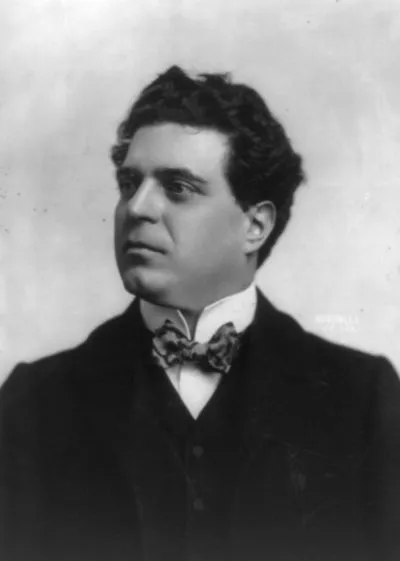
Pietro Mascagni 波特罗·马斯卡尼
波特罗·马斯卡尼
P·Mascagni / P·马斯卡尼地区意大利
类型个人
职业作曲
艺人资料
波特罗·马斯卡尼(Pietro Mascagni,1863—1945年),意大利作曲家、指挥家。1863年12月7日生于里窝那,1945年8月2日卒于罗马。他父亲是面包师,一心想把儿子培养成法学家,但马斯卡尼却偷偷地在凯鲁比尼音乐学院师从A·索弗雷迪尼学习。后又赢得某伯爵的赏识,于1882年资助他进米兰音乐学院,师从A.蓬基耶利等深造。但因无法忍受学院的严格课程,只学了2年中途退学,担任旅行歌团的指挥。此后曾在一些三流巡回歌剧团里担任指挥,几乎走遍了整个意大利。最后在切里尼奥拉定居,埋头创作和在市音乐学校任职。
个人经历
1.处女作的故事
1889年,他因偶然的机会,以新作的独幕歌剧《乡村骑士》参加由出版家E.松佐尼奥主办的创作比赛,荣获一等奖。次年此剧在罗马首演获得成功,使他一举成名。作曲家以19世纪后期意大利西西里的一个乡村中两对男女的感情瓜葛,最后男主人公图里杜决斗身亡的故事,反映普通青年农民日常生活的一个侧面。剧中的乡村教堂象征人们的虔诚信仰和高尚的灵魂,而与此形成极大反差的却是狂热的三角恋爱和不可遏止的复仇意识。豪放乐观的马车夫阿尔菲奥得知其妻罗拉与服役回乡的图里杜旧情复发热烈相恋之后,怒不可遏,最终杀死了图里杜,而图里杜的忠实爱人桑图扎却成为乡村中最可悲的女人。歌剧音乐富于西西里岛民间风格,幕启之前传来的图里杜的歌声:“啊,罗拉,你如同春日之花”,为全剧音乐提供了基本格调,桑图扎悲伤的咏叹调《你知道吗?好妈妈》更是一首凄婉动人的歌,第八场与第九场之间管弦乐演奏的间奏曲成为歌剧间奏曲的范例。
2.个人风格
马斯卡尼强调旋律的叙事性以求更贴近生活,因此他喜欢咏叙调风格,擅长戏剧性的效果,使幽静与躁动、炽烈与抒情有强烈的对比。他常让管弦乐队独立与歌声并列,使它不仅仅只是从属的伴奏。他一生写了15部歌剧,
3.代表作品
《友人弗里兹》(1891)、《伊利丝》(1898)、《假面具》 (1891)、《伊萨博》(1911)、《小马拉特》(1921)等,艺术水平均比《乡村骑士》逊色。令人遗憾的是,这位杰出的作曲家是法西斯主义的信徒,他于1935年为逢迎墨索里尼创作了歌剧《尼禄》。这使他名誉扫地,包括托斯卡尼尼在内的许多正直的音乐家立即与其绝交。第二次世界大战结束3个月后,马斯卡尼在孤寂中死去。
摘自:https://baike.baidu.com/item/%E6%B3%A2%E7%89%B9%E7%BD%97%C2%B7%E9%A9%AC%E6%96%AF%E5%8D%A1%E5%B0%BC
English Introduction
Pietro Antonio Stefano Mascagni(Italian:[ˈpjɛːtro anˈtɔːnjo ˈsteːfano masˈkaɲɲi]; 7 December 1863 – 2 August 1945) was an Italiancomposermost noted for hisoperas. His 1890 masterpieceCavalleria Rusticanacaused one of the greatest sensations in opera history and single-handedly ushered in theVerismomovement in Italian dramatic music. While it was often held that Mascagni, likeLeoncavallo, was a "one-opera man" who could never repeat his first success,L'amico FritzandIrishave remained in the repertoire in Europe (especially Italy) since their premieres.Mascagni said that at one point,Iriswas performed in Italy more often thanCavalleria(cf. Stivender).
Mascagni wrote fifteen operas, an operetta, several orchestral and vocal works, and also songs and piano music. He enjoyed immense success during his lifetime, both as a composer and conductor of his own and other people's music. He created a variety of styles in his operas: a Sicilian passion and warmth of Cavalleria, the exotic flavor of Iris, the idylls of L'amico Fritz and Lodoletta, the Gallic chiaroscuro of Isabeau, the steely, Veristic power of Il piccolo Marat and the over-ripe post-romanticism of the lush Parisina.
Mascagni was born in Livorno, Tuscany, the second son of Domenico and Emilia Mascagni. His father owned and operated a bakery. Giovanni Targioni-Tozzetti("Nanni") was born the same year in the same city and became Mascagni's lifelong friend and collaborator.
In 1876, at the age of 13, Mascagni began musical studies with Alfredo Soffredini, who founded the Instituto Musicale di Livorno (later called Istituto Cherubini). Soffredini had just completed his musical studies in Milan. Also a native of Livorno, Soffredini was a composer, teacher and musical critic. Mascagni started composing rapidly: between 1879 and 1880, he wrote several works: Sinfonia in do minore, Prima sinfonia in fa maggiore, Elegia, Kyrie, Gloria and Ave Maria.
The premiere of Mascagni's first cantata, In Filanda, took place at the Istituto Cherubini on 9 February 1881. Performed at a musical contest in Milan, the cantata won the first prize. In the same year Mascagni met the musicians Arrigo Boito and Amilcare Ponchielli in Milan.
In 1882, he composed his Cantata alla gioia from a text by Friedrich Schiller, followed by La stella di Garibaldi for voice and piano, and La tua stella. On 6 May Mascagni left Livorno for Milan. He passed the admission examination of the Milan Conservatory on 12 October. In Milan, Mascagni met the noted composer Giacomo Puccini.
On 9 January 1883, Mascagni's sister, Maria, died. The cantata In Filanda became Pinotta, and was proposed for the musical contest of the Conservatorio, but as his registration was late, it was not accepted.
In 1884, he composed Ballata for tenor and piano; M'ama non m'ama, scherzo for soprano and piano; Messagio d'amore, and Alla luna.
In 1885, Mascagni composed Il Re a Napoli in Cremona, a romance for tenor and orchestra, on a text by Andrea Maffei. He left Milan without completing his studies. That year, he began touring as a conductor in the operetta companies of Vittorio Forlì, Alfonso and Ciro Scognamiglio, and, in Genoa, the company of Luigi Arnaldo Vassallo.
Mascagni met the impresario Luigi Maresca in 1886 and started working with him. That December, Mascagni arrived in Cerignola with Maresca's company. He was accompanied by Argenide Marcellina Carbognani (Lina), his future wife. Helped by the mayor Giuseppe Cannone, Mascagni soon left the company of Maresca, though not without problems.
He was appointed as the master of music and singing of the new philharmonia of Cerignola. His reputation grew. He also gave piano lessons. In February 1888, he began work on the Messa di Gloria. In July, Casa Sonzogno announced in the Teatro Illustrato its second competition for a one-act opera. The following year, Mascagni completed his composition of Cavalleria rusticana on 27 May and sent the manuscript to Milan.
Mascagni married Lina Carbognani on 3 February 1889. The next day their first son, Domenico Mascagni ("Mimì"), was born. Their son Dino was born on 3 January 1891. A daughter, Emi, was born in 1892.
On 21 February 1890, Mascagni was summoned to Rome to present his opera. The première of Cavalleria rusticana, winner of the Sonzogno contest, was held 17 May at the Teatro Costanzi in Rome. It had outstanding success, and the opera was soon performed in both the north and south of Italy: Florence, Turin, Bologna, Palermo, Milan, Genoa, Naples, Venice and Trieste.
In December, Gustav Mahler conducted the opera in Budapest. Soon thereafter, the cities of Munich, Hamburg, St. Petersburg, Dresden and Buenos Aires welcomed the opera. In March 1891, it was sung in Vienna. At age 26, Mascagni had become internationally famous.
Mascagni premiered his L'amico Fritz, his second most successful opera, on 31 October 1891 at the Teatro Costanzi in Rome. I Rantzau was premiered on 10 November at the Teatro La Pergola, in Florence, under his personal direction.
The composer next completed Silvano (1894). On 16 February 1895 he premiered Guglielmo Ratcliff at the Teatro alla Scala of Milan. On 15 March Silvano was premiered at the same theatre. That year, Mascagni accepted the directorship of the Liceo Rossini in Pesaro and moved his family there.
On 2 March 1896, Mascagni conducted the première of Zanetto at the Liceo. He continued his composing and directing. On 29 June 1898 in Recanati, Mascagni conducted the première of a symphonic poem, A Giacomo Leopardi. Mascagni began a collaboration with Luigi Illica, a librettist. Their first work, Iris, was premiered on 22 November at the Teatro Costanzi in Rome.
Mascagni's father died in May 1899.
In 1900, Mascagni toured Moscow and St. Petersburg and, on 17 January 1901, Le maschere was premiered in six Italian theaters. Giuseppe Verdi died on 27 January and the following month Mascagni commemorated Verdi's passing. That same year, he conducted Verdi's Requiem in Vienna.
Mascagni composed the incidental music for Hall Caine's play, The Eternal City in August 1902; the première of the play with Mascagni's music took place in London on 2 October.
In 1902 and 1903, he toured in Canada and in the United States, (in particular Montreal, New York City, Philadelphia, Boston and San Francisco), where he conducted many of his and other composers' works. The tour was mostly a fiasco, except for the visit to San Francisco where Mascagni was extremely well received.
In 1903, Mascagni left Pesaro after problems with the authorities. He became director of the Scuola Musicale Romana, in Rome. In the same year he signed a contract with the French editor Paul de Choudens.
Amica, based on a poem by Choudens with French libretto by Paul Collin, was premiered on 16 March 1905, in Monte-Carlo. That year, he had disputes with Ruggiero Leoncavallo and Giacomo Puccini. He also had the Livornese première of Le maschere.
Mascagni was director of the Costanzi for the season beginning in August 1909.
On 4 April 1910, Mascagni began a relationship with Anna Lolli. In October he was reconciled with Puccini.
Mascagni ceased his activity as director of the Scuola Musicale Romana in 1911. That May he left for Buenos Aires, beginning a seven-month tour in South America. The première of Isabeau took place in Buenos Aires on 2 June.
The Italian première of Isabeau was held simultaneously at La Scala in Milan (conductor Tullio Serafin) and at La Fenice in Venice(conductor Mascagni) in 1912. On 28 March, he began to work on Parisina in Bellevue, near Paris, sometimes with his daughter Emi, his mistress Anna Lolli, and the librettist Gabriele d'Annunzio.
Parisina was premiered in Milan on 15 December of that year. Almost all the important Italian composers of the time were present, among them Puccini, Umberto Giordano and Riccardo Zandonai. The new work was premiered in Livorno and Rome in 1914. On 28 July occurred the events that shortly led to World War I: Puccini and Mascagni were against the involvement of Italy in this war, in which Mascagni's son Dino was later made a prisoner.
In 1915 Mascagni wrote music for Nino Oxilia's movie Rapsodia Satanica; the custom was for silent films to be accompanied live in a theater by organ, piano, or an orchestra, often using a prepared score (sometimes with original music) with cues for the conductor or musician. Mascagni had a quarrel regarding the rights of Louise de la Ramée's Two Little Wooden Shoes (I due Zoccoletti), that inspired both Puccini and Mascagni. The subject was retained by Mascagni for Lodoletta. The latter opera was premiered on 30 April 1917 in Rome. The Livornese première of the opera was on 28 July with Beniamino Gigli as Flammen.
Sì, Mascagni's operetta - which he had been manoeuvred into writing by the impresario Carlo Lombardo, was premiered on 13 December in Rome.
In 1920 Mascagni composed Il piccolo Marat, which was premiered in Rome on 2 May 1921, following by a premiere in Buenos Aires in September. The composer returned to South America for a tour beginning in May 1922.
In 1923, he composed Visione Lirica. He moved to the Grand Hotel Plaza in Rome in 1927, a place he would not leave until his death.
In 1930, Mascagni conducted La bohème in Torre del Lago, as a homage to Puccini, who had died in 1924. In 1931, Le maschere was performed at La Scala.
Pinotta was premiered in San Remo on 23 March 1932. He joined the PNF (Fascist party), following the example of many contemporary musicians, including Giordano.
Nerone was premièred in Milan on 16 January 1935, followed by the première in Livorno on 24 August.
In June 1936, Mascagni's son Dino died in Somalia.
In 1940, celebrations for the fiftieth anniversary of his most popular opera, Cavalleria rusticana, took place all over Italy, often with Mascagni conducting. The opera was recorded for La Voce del padrone ("His Master's Voice") at La Scala under the direction of Mascagni, who recorded a special spoken introduction. EMI later reissued the recording on LP and CD.
In 1942, after an audience with Pope Pius XII, newspapers quoted Mascagni, a Roman Catholic, as saying that his tuberculosis-stricken niece was cured after receiving a rosary and silver medal blessed by the pope.
In April 1943, Mascagni appeared for the last time at La Scala to conduct L'amico Fritz. By that time he had to conduct sitting on a chair. The last season of Mascagni at the Rome Opera (Cavalleria rusticana and L'amico Fritz) was 1944–45.
Mascagni died on 2 August 1945 in his apartment at the Grand Hotel Plaza. The funeral ceremony was on 4 August. The Italian authorities were not present. In 1951, the mortal remains of Mascagni were transferred from Rome to Livorno, where Mascagni finally received an official homage.
During his long career, Mascagni contemplated writing many operas. The following is an incomplete list of such projects, which never saw the light of day:
The 1990 film The Godfather Part III used a production of Cavalleria rusticana at the Teatro Massimo in Palermo as the setting for its climax, with Michael Corleone's son Anthony as Turiddu. The movie ends with the Intermezzo playing.The sound track of the 1980 film Raging Bull uses the Intermezzo from Cavalleria rusticana, the Barcarolle from Silvano, and the Intermezzo from Guglielmo Ratcliff (known as Il sogno di Ratcliff).
In 2001 Andrea Bocelli recorded a song entitled "Mascagni" on his Cieli di Toscana album that had an excerpt from "Cavalleria rusticana" incorporated into the music.
From:https://en.wikipedia.org/wiki/'>https://en.wikipedia.org/wiki/Pietro Mascagni