
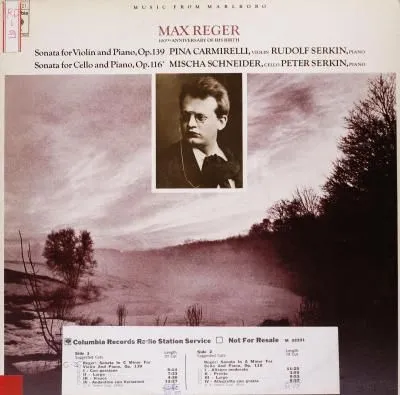
雷格《C大调第7小提琴奏鸣曲OP.139》《a小调第4大提琴奏鸣曲OP.116》/卡米莱里,施奈德,塞尔金等演奏
GenreAlbum
Year1973
Introduction
专辑介绍:REGER: VIOLIN&CELLO SONATA Side 1 REGER: SONATA IN C MINOR FOR VIOLIN AND PIANO, Op. 139 PINA CARMIRELLI, Violin RUDOLF SERKIN, Piano I—Con passione II—Largo III—Vivace IV—Andantino con Variazioni Side 2 . REGER: SONATA IN A MINOR FOR CELLO AND PIANO, Op. 116 MISCHA SCHNEIDER, Cello PETER SERKIN, Piano I—Allegro moderato II—Presto III—Largo IV—Allegretto con grazia Max Reger was bom in 1873. As with Rachmaninoff, the centenary of his birth has now been reached.Rachmaninoff died at the age of 70 and wrote relatively few works; most of them have been recorded, and some of them are among the most popular in the standard repertory. Reger died at the age of 43 and wrote a staggering number of works; only a handful of them has been recorded, and there is perhaps no single Reger work that can be described as standard repertory. In Germany, he is better known than elsewhere; however, judging from the small number of recordings issued by German recording companies—mostly the two big sets of orchestral variations on themes by Mozart and Johann Adam Hiller—he is far from popular even in the land of his birth. He wrote 200 songs, but, thus far, even the indefatigable Dietrich Fischer-Dieskau seems not to have investigated them.Why this neglect of a composer who is generally regarded, along with Mahler and Richard Strauss, as a major figure of early-20th-century German music? Well, Reger has had no lack of hostile critics. His entire short life was accompanied by raucous and carping criticism almost from the first, and Reger did not make things easier for himself by his personal manner: By all accounts, he was as prickly and boorish as Beethoven, with something of Beethoven’s uncouth sense of humor. He called his critics fools, and went his own uncompromising way. He thought of himself, as did most of his contemporaries, as a radical innovator. We now see him as a composer of the mainstream, a child of the late-Romantic era who turned to Bach for inspiration. In 1905, he wrote in the journal Die Musik: "Sebastian Bach is for me the beginning and end of all music, the solid foundation of any true progress! ... A sure cure, not only for all those composers and musicians who are sick of 'indigestible Wagner,’ but for all those 'contemporaries’ who suffer from any sort of spinal atrophy. To be 'Bachisch’ means to be thoroughly German, intransigent.”But Reger also admired Brahms; Bach and Brahms were, in fact, the twin gods of Reger’s pantheon. "What guarantees immortality to Brahms,” he wrote, "is by no means his attachment to old masters, but rather the fact that he was able to produce new undreamed-of spiritual moods, on the basis of his own individual spirit. Here is the basis of all immortality, not the mere * attachment to old mas-ters, which, by itself, stern history converts to a death sentence within a few decades.”So Reger used Bach and Brahms as solid foundations on which to build new structures. His chief innovation is in the field of harmony. "His conspicuous counterpoint was dominated by a kind of harmony quite unlike Bach’s,” says William W. Austin in Music in the 20th Century. "Even in Reger’s many fugues, the chief interest lies in the swift chord-progressions, rather than in the interplay of melodies. ’ The chords themselves are mainly orthodox. "What was new about his way of writing," says British musicologist Eric Blom, "was that it often scorned any sort of rational progression and took to a manner of modulation that linked chord to chord by a series of jerks —and unfortunately the manner degenerated into a mannerism so often repeated as to become tiresome at best or unbearable at worst, according to taste and prejudice.”Blom’s statement, though put in a scholarly context, is an example of the kind of buckshot that was constantly fired at Reger during his lifetime. Today, with our ears thoroughly emancipated from all rules of chord-progression by Schoenberg, Bartók and others, Reger’s harmony is unlikely to give us much trouble. What we ask of him, as of all composers, is an individual and compelling voice. Rachmaninoff had such a voice, though he was a traditionalist writing in a style that his critics scorned as outmoded. With Reger, the evidence is not yet all available; one would wish to become familiar with the piano music, the songs, the choral works and more of the chamber music. One would also wish, as did Arnold Schoenberg, that, "Reger must be done often; 1, because he has written a lot; 2, because he is already dead and people are still not clear about him. (I consider him a genius.)”Reger was especially attracted to chamber music and composed more of it than any comparable figure of his time. The list includes three striug quartets,two piano quartets, two. piano quintets, a clarinet quintet, three string trios, two piano trios, seven violin sonatas, five cello sonatas, three clarinet sonatas, and eleven sonatas for violin solo.The Fourth Cello Sonata, Op. 116 (published in 1911), is an example of Reger’s mature chamber music style, and makes a better display of his undeniable powers than many of his more ambitious scores. The first movement, Allegro moderato, is nominally in A Minor, but its » chromaticism is so varied that no one key manages to establish itself. The players are often directed to play agitato or delicatamente, and the movement, full of unappeased longing (and Brahmsian echoes), hovers between these two contrasting moods. The second movement, a scherzo, begins with soft descending octaves for the piano, answered by an ascending cello line. It is a mysterious, almost weird, section, with some hobgoblin pizzicato effects. The trio is marked Meno presto and combines solid chordal movement in the piano with staccato and pizzicato comments from the cello. The third movement, Largo, returns to the mood and chromatic texture of the first movement. Reger exploits the natural songfulness of the cello in the opening statement. The movement is technically interesting because the two instruments rarely share each other’s material; they dovetail but still retain their distinct entities. The finale, Allegretto con grazia, is a kind of rondo built on two contrasting and alternating sections. The first is gracious, antique, suggestive of Mozart with "wrong” notes. The second is assertive and masculine. A few quiet bars marked quasi adagio bring the sonata to a close.The Seventh Violin Sonata, Op. 139, was composed in April 1915 and published in the same year. It was Reger’s last violin sonata, and, according to his wife, Elsa (Mein Leben mit und fur Max Reger), he said of it, "Jetzt beginnt der freie Jenaische Stil bei Reger” ("Now begins Reger’s free, Jena style”). Perhaps he was referring to the very free form of all four movements: The first looks like it is in sonata form but lacks a real development and recapitulation; the second suggests a slow song-form without actually being in song-form; the third is scherzo; and the fourth is an unorthodox set of variations. Curiously, Reger avoids double-stopping throughout the entire sonata. The violin plays a single melody line, usually etched in strong relief against the piano part, which takes on the harmonic role and is densely chordal. The first movement, Con passione, begins with octave unisons in violin and piano; the violin swings itself high above the staff through most of this movement, occasionally descending for quieter moments (a tranquillo second theme, which appears a second time, marked quasi adagio). Though ostensibly in C minor, and eventually reaching a C-minor cadence, the harmony is constantly shifting throughout this turbulent opening movement. The second movement is a Largo, written as though in D major; the warm opening melody on the violin’s G string is eventually disrupted by an agitato outburst, but returns more radiant than ever. There are echoes of Brahms and Tristan in this movement. The scherzo (Vivace, A minor) is surprisingly prophetic of Shostakovich in its scampering, skeletal tracery; the pianist is, for once, relieved of his burden of thick chords and asked to play soft staccato figures. The finale is an Andantino con Variazioni. The theme, stated by the violin, is a lied-like melody of great serenity. It is not always easily traced in the ensuing variations, but some element of it can be found in each. The key signature, as well as the tempo, changes for each variation, but because of the chromatic harmony one cannot usually pinpoint the key. Variation 1 is a more elaborate setting of the theme. Variation 2 (Adagio) gives Bach-like 32nd notes to the piano, while the violin plays fragments of the theme. Variation 3 (Piu mosso) is largely in F-sharp minor, with wide-spaced triplets in the piano part. Variation 4 (Allegretto) is marked grazioso; the piano takes the lion’s share, with flute-like in- ' terjections from the violin. Variation 5 is an extended Poco vivace, and Variation 6 a Largo (theme in the piano). Variation 7 is a swift 6/8 Vivace; the violin is muted in the sustained middle section. Variation 8, Moltc sostenuto, is only 14 bars long. In the final variation, Adagietto, the theme is sung expressively by the violin, in C major, against a wide-ranging but delicate piano background. —David JohnsonSonata In C Minor For Violin And Piano, Op. 139Piano – Rudolf SerkinViolin – Pina Carmirelli A1 I - Con Passione 9:14 A2 II - Largo 7:33 A3 III - Vivace 4:36 A4 IV - Andantino Con Variazioni 12:27 Sonata In A Minor For Cello And Piano, Op. 116Cello – Mischa SchneiderPiano – Peter Serkin B1 I - Allegro Moderato 11:25 B2 II - Presto 3:55 B3 III - Largo 9:53 B4 IV - Allegretto Con Grazia 8:52 Credits Composed By – Max RegerDesign [Cover Design] – Henrietta CondakEngineer – Edward T. GrahamPhotography By [Cover Landscape Photo] – Victor PilisofProducer – Mischa Schneider (tracks: A1 to A4), Thomas Z. Shepard (tracks: B1 to B4)