奥古斯汀·巴利奥斯 Agustín Barrios
奥古斯汀·巴利奥斯
Barrios / 巴利奥斯RegionParaguay
TypeSolo
ProfessionComposer, Guitarist
Artist Profile
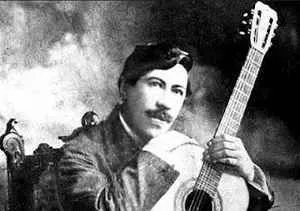
Agustín Pío Barrios(also known asAgustín Barrios MangoréandNitsuga—Agustin spelled backwards—Mangoré; May 5, 1885 – August 7, 1944) was a Paraguayanvirtuosoclassical guitaristand composer, largely regarded as one of the greatest performers and most prolific composers for the guitar.
It has been generally accepted that Barrios was born in San Juan Bautista de las Misiones, Paraguay. However, there is no definitive proof of this as his baptismal document found in the book of registries in the cathedral in San Juan Bautista does not state his precise place of birth. Also, several biographers and authorities present convincing documented evidence that Barrios was born, instead, in the nearby town of Villa Florida, Misiones, situated on the Tebicuary River some 30 km north of San Juan Bautista.[citation needed]
When he was a child, Barrios began to develop a love for music and literature, two areas that were very important to his family. Barrios would eventually speak two languages (Spanish and Guarani), and read three more (English, French and German).
Barrios began to show an interest in musical instruments, particularly the guitar, before he reached his teens. He went to Asunción in 1901, at the age of fifteen, to attend a university (Universidad Nacional de Asunción) with a scholarship in music, thus becoming one of the youngest university students in Paraguayan history. Apart from his studies in the college's music department, Barrios was also well appreciated by members of the college's mathematics, journalism and literature departments.
After leaving college, Barrios dedicated his life to music and writing poems. He composed more than 300 songs for which he would first write the lyrics and then the guitar accompaniment. Barrios made several friends during his multiple trips across South America. He was known for giving his friends and fans signed copies of his poems. Because of that, there are several different versions of his poetical works which have surfaced across South America, other areas of Latin America and the United States. Many current collectors warn potential buyers to be careful when they come across a poem reportedly autographed by Barrios.
Barrios was famed for his phenomenal performances, both live and on gramophone recordings. Barrios has been credited as the first classical guitarist to make recordings, in 1909/10, but the earliest known recording were by guitarists Luis and Simon Ramirez, onto cylinders, for the "Viuda de Aramburo" label, in Madrid, between 1897 and 1901. Barrios at times performed in concert in traditional Paraguayan dress (he was partly of Guaraní origin), using the pseudonym of Nitsuga Mangoré ('Nitsuga' being Agustín spelled backwards, and 'Mangoré' being the name of a cacique of the South American indigenous group Timbú).[citation needed]
His works were largely late-Romantic in character, despite his having lived well into the twentieth century. Many of them are also adaptations of, or are influenced by, South American and Central American folk music. Very many of them are of a virtuosic nature.
The Johann Sebastian Bach-inspired La Catedral, from 1921, is widely considered to be Barrios' magnum opus, even winning the approval of Andrés Segovia, who said "In 1921 in Buenos Aires, I played at the hall La Argentina noted for its good acoustics for guitar, where Barrios had concertized just weeks before me. He was presented to me by his secretary Elbio Trapani. At my invitation Barrios visited me at the hotel and played for me upon my very own guitar several of his compositions among which the one that really impressed me was a magnificent concert piece The Cathedral whose first movement is an andante, like an introduction and prelude, and a second very virtuosic piece which is ideal for the repertory of any concert guitarist. Barrios had promised to send me immediately a copy of the work (I had ten days remaining before continuing my journey) but I never received a copy." However, it equally possible that Segovia did receive the score and chose not to play it, either out of distaste for Barrios' folk-based music or professional jealousy (because Barrios was more of a composer than he was).
After touring Europe in 1936 Barrios performed in Venezuela, Haiti, Cuba, Costa Rica, Nicaragua, El Salvador and Guatemala. Several writers have suggested that Barrios revisited Mexico in 1939, but his immigration file with the Mexican government did not include an entry for him or his wife Gloria that year. He would not fulfill his dream to reach the United States. It has been suggested that his partner Gloria's travel visa was denied however no documentation has ever been found supporting this.
He reportedly suffered a myocardial infarction in 1939 and was strongly advised to limit touring to reduce stress. He accepted the invitation of Maximiliano Hernández Martínez, then President of El Salvador, to move to El Salvador.
From 1939 onwards Barrios lived in San Salvador; after recovering, he accepted Hernandez Martinez appointment as Head of Classical Guitar at the National Conservatory.
He died on August 7, 1944.
Barrios refused to teach during his career as active performer, only providing guitar instruction after arriving in El Salvador to twelve selected maestros, all of Salvadoran nationality.
They were known as the Twelve Mangoreans:
Luis Mario Samayoa ( -1969), Benjamín Cisneros ( -1987), Rubén Urquilla ( -1993), René Cortés-Andrino ( -1995), Mario Cardona Lazo ( -1999), Jesús Quiroa ( -2001), Jose Cándido Morales ( -2002), Julio Cortés-Andrino ( -2006), Cecilio Orellana ( -2007), Roberto Bracamontes ( -2007), Víctor Urrutia ( -2010) and Elena Valdivieso.
Jose Cándido Morales was the only to learn from Barrios as live-in student. After Barrios' death, Morales remained the gatekeeper of Barrios' legacy, technique and late works.
The folk music of Paraguay (including the polca paraguaya and vals) provided the young Barrios with his first introduction to music. In 1898, Barrios was formally introduced to the classical guitar repertoire by Gustavo Sosa Escalada. At that time, Barrios had already composed works for the guitar, and also performed pieces written by his former teacher Alias, such as La Chinita and La Perezosa. Under the influence of his new teacher, Barrios went on to perform and study the works of Tárrega, Vinas, Sor and Aguado. Sosa Escalada was so impressed with his new pupil that he convinced Barrios's parents to let him move to Asunción to continue his education. Having already surpassed the technical and performing abilities of most guitarists, Barrios began seriously to compose around 1905.
Among the folkloric influences, Barrios is known to have played such popular Paraguayan works as "Campamento Cerro León", "Londón Carapé", "Guyrá campana", "Mamá Cumandá". As an example, "Guyrá campana" is very interesting, since some of the material can be heard in parts of Barrios' recording of "Caazapá — Aire Popular Paraguayo"... Though "Guyrá campana" is traditional music, many maintain that it is very closely related to guitarist Carlos Talavera 1 (from Caazapá), whom Barrios knew. There are various versions of "Guyrá campana" (it is also known as "Pájaro campana") e.g. for Paraguayan harp (Félix Pérez Cardozo), etc.; and in some versions, the birdsong imitations can be very clearly heard.
Barrios's compositions can be divided into three basic categories: folkloric, imitative and religious. Barrios paid tribute to the music and people of his native land by composing pieces modeled after folk songs from South America and Central America. Imitating the compositional style and techniques of the Baroque and Romantic periods was another side to his craftsmanship. "La Catedral" may be viewed as Barrios' tribute to Bach. It is believed that "La Catedral" was inspired by a religious experience for Barrios; therefore, the piece may also be categorized under religion. Religious beliefs and experiences also played an important role in Barrios' compositional process. Una Limosna por el Amor de Dios (Alms for the Love of God) is another example of a religiously-inspired work. Breaking down the works of Barrios into these three categories helps the guitar enthusiast to understand Barrios's musical intent.
From:https://en.wikipedia.org/wiki/Agust%C3%ADn_Barrios
奥古斯丁•巴里奥斯 ,一位十九与二十世纪之交的奇特作曲家。南美洲是一片神奇的土地,各种文化在这片大陆上织成斑斓的图景,色彩丰富得令人头晕目眩。奥古斯丁•巴里奥斯就是这个文化万花筒的代表人物,你可以想象这样一幅图景,一位印第安酋长,怀抱着一把西班牙吉他,在西方式的音乐舞台上,演奏巴赫、贝多芬、肖邦和他自己的作品。这位印第安酋长就是奥古斯丁•巴里奥斯,他成名后就是以一副印第安土著打扮登台演出,并自称“传奇瓜拉尼酋长曼哥罗”(Gualani指巴拉圭、阿根廷北部和巴西南部的南美洲印地安人)。听起来有点江湖艺人的味道,但这位南美音乐家革新了吉他演奏技巧,留下了大量一流的吉他曲目。1944年去世后,一度湮没无闻。但从七十年代开始,一批南美洲吉他演奏家重新复兴了巴里奥斯的作品。 巴里奥斯1885年生于南美巴拉圭的首府圣•胡安,具有印第安人的血统。他13岁才开始碰吉他,但显然,他具有这方面的非凡天赋,25岁那年,巴里奥斯在阿根廷全国举行了盛况空前的巡演,此后二十年间,巴里奥斯几乎跑遍了南美大陆的每个角落,从贫瘠的山村到总统官邸,要知道在二十世纪早期,南美大陆的交通极为原始,这位印第安演奏家的精力和体力简直是个超人。二十世纪三十年代,巴里奥斯甚至身着南美印第安土著服装,怀抱吉他,去了欧洲,巡演的国家包括西班牙、比利时和德国。这也是欧洲人听到的第一位南美吉他演奏家。在吉他的故乡西班牙,人们惊叹巴里奥斯的非凡技巧,称他为吉他上的帕格尼尼。巴里奥斯的吉他演奏技巧高超,据说这来自他少年习琴时,并没有按部就班地按照传统教材,而是大量演奏巴赫、贝多芬与肖邦作品的改编曲,由于这些作品原来都是为钢琴写作的,移植到吉他上,技巧困难了很多。从而巴里奥斯掌握了惊人的技巧秘诀,以及纯正的古典趣味,他是二十世纪最早尝试将大量古典浪漫作品改编为吉他独奏的作曲家,出了上面提到的三位作曲家之外,巴里奥斯还改编了舒曼、格里格、门德尔松、柴可夫斯基的钢琴作品。但对巴里奥斯影响最大的则是巴赫。 1921年,巴里奥斯三十六岁,正值精力和体力的顶峰,他参观了巴拉圭圣胡安大教堂后,模仿巴赫的管风琴作品风格,写作了一部双乐章的吉他独奏曲《大教堂》。 巴里奥斯的音乐中总有萦绕不去的伤感气质,有人猜测,这是因为巴里奥斯长期在外漂泊巡演,远离家乡的愁绪也深深印刻在他的音乐中。不过,忧郁气质也许就是巴里奥斯的天性。巴里奥斯在历经了三十年的大红大紫之后,定居于南美萨尔瓦多首府,在那里他度过了最后的岁月,1944年去世。巴里奥斯去世后,他的音乐一度被人遗忘,这可能是因为从二十世纪音乐的走势来看,巴里奥斯风格保守,始终留恋十九世纪的余韵,对于日新月异的时代而言,他过于老派了。到了七十年代,多元主义抬头,现代风格的涵义更为丰富了,人们重新发现了巴里奥斯那些美妙的音乐。古巴作曲家和吉他演奏家Leo Brouwer在重新评价巴里奥斯的音乐时提到,就连巴赫那样伟大的作曲家也不是与时俱进,是否紧跟潮流并不是评价标准,巴里奥斯留下的三百多首精美作品将进入所有吉他演奏家的保留曲目。