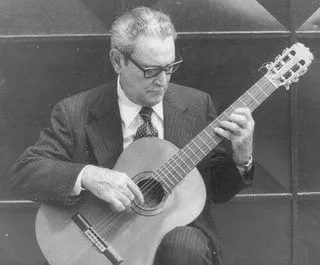
安东尼奥·劳罗 Antonio Lauro
安东尼奥·劳罗
A·Lauro / A·劳罗RegionVenezuela
TypeSolo
ProfessionComposer, Guitarist
Artist Profile
安东尼奥·劳罗 编辑 同义词 Antonio Lauro一般指安东尼奥·劳罗安东尼奥·劳罗,1917年8月3日出生于玻利瓦尔,1986年4月18日卒于卡拉加斯。委内瑞拉音乐人。 他父亲是一个会弹吉他又喜欢唱歌的理发师,但不幸的是他在劳罗五岁的时候就过世了,此后劳罗一家搬到了加拉斯加。随后,劳罗在迪克拉马森音乐学院学习钢琴和作曲,他的老师包括著名的作曲家索约。作品有《委内瑞拉圆舞曲3号》等。 中文名 安东尼奥·劳罗 外文名 Antonio Lauro 国 籍 委内瑞拉 出生地 玻利瓦尔 出生日期 1917年8月3日 逝世日期 1986年4月18日 目录 1 早年经历 2 演艺经历 3 主要作品 4 获奖记录
早年经历 编辑 安东尼奥·劳罗 安东尼奥·劳罗,1932年他有幸聆听了巴拉圭传奇人物巴利奥斯的音乐会,这次经历对于劳罗的影响无疑是决定性的,此时已是一个熟练的民间吉他手的劳罗决定彻底放弃钢琴和小提琴,转而将毕生的精力投入到吉他音乐之中。1933年后,他和劳尔·博格斯(Raúl Borges,1888-1967)一起学习,在这期间,博格斯向他介绍了传统的古典吉他曲目。在随后的十年里,博格斯的学生们,包括里维拉(Rodrigo Riera)、西斯纳罗斯(José Rafael Cisneros)和迪亚兹(Alirio Díaz)成为了将劳罗的作品展示给全世界的听众的关键人物。同时,他们也将这些作品介绍给了塞戈维亚和约翰·威廉斯,这些顶级演奏家的赏识大大提高了劳罗的知名度。
演艺经历 编辑 邮票上的安东尼奥·劳罗 和同年代许多南美人一样,劳罗是一个赤诚的文化民族主义者,并毕生致力于挽救和发扬本民族的音乐传统。1935到1943年间,他是Cantores del Trópico三人组合中的一员,他唱低音部并弹奏吉他和四弦吉他。他们巡回了附近很多个国家去向人们介绍委内瑞拉音乐。其间,一些上个世纪的民族作曲家,诸如帕拉西奥斯(Ramón Delgado Palacios ,1867-1902),所创作的很多描写殖民生活的圆舞曲吸引了他。无穷动的旋律、一浪高过一浪的激情、鲜明的节奏特点,在欧洲,斯美塔那和格拉纳多斯正是用类似这样的民间音乐素材,大大提升了自己本民族艺术的地位。而著名委内瑞拉钢琴家卡斯特尔拉诺斯(Evencio Castellanos,1914-1984)所创作的一系列钢琴圆舞曲作品更使劳罗坚信,在吉他的保留曲目当中,也应该有这样的一些作品。后来大家知道的塔蒂阿娜(Tatiana)、安德雷娜(Andreina)以及纳塔里亚(Natalia)都是他在这个方向上努力的第一批成果。这些作品是在1938到1940年间创作的,它的受欢迎程度不仅鼓舞了劳罗自己,还带动了其他委内瑞拉音乐人。除了吉他作品之外,劳罗还为管弦乐队、合唱团、钢琴以及声乐谱写了很多曲目,其中有很多至今未能正式出版。虽然劳罗有时也尝试使用现代谱曲技巧,但是他的大多数吉他作品本质上仍然属于可以在街头巷尾广为传播的通俗民间音乐,这是也是他那个年代音乐家们最喜欢也是最直接的表达方式。 在1951-1952年间,劳罗因为他强烈的民主主义信仰而被军阀头目吉门内兹(Marcos Pérez Jiménez)监禁。后来劳罗对这段经历表现出了无所谓的态度,他对他的朋友们说,监狱生活对于他那个时代的委内瑞拉人来说是太正常不过了。即使在监狱中他仍坚持作曲,而且在被释放后立即加入了如日中天的劳尔·博格斯古典吉他三重奏组。在随后的几十年里,劳罗的作品在全世界被发行、录音和演奏,他对民族音乐的贡献被广泛认可和承认。劳罗也被几个著名学校聘为吉他教授,其中包括Juan José Landaeta音乐学院,同时他也是委内瑞拉交响乐团管弦乐队的名誉负责人。尽管他谦虚的坚持他只是一个作曲家而不是演奏家,但他还是被朋友们说服去进行了一个独奏音乐旅行。旅行从委内瑞拉开始,并在1980年伦敦维格摩尔大厅的演奏中达到了高潮。
主要作品 编辑 《委内瑞拉圆舞曲3号》等。
获奖记录 编辑 1986年,在他逝世前不久,他被授予了国家音乐大奖,在委内瑞拉,这是一个艺术家所能获得的最高荣誉。
摘自:<a href="<a href=" https:="" baike.baidu.com="" item="" %e5%ae%89%e4%b8%9c%e5%b0%bc%e5%a5%a5%c2%b7%e5%8a%b3%e7%bd%97="" 11058311?fr="aladdin&fromid=184849&fromtitle='">https://baike.baidu.com/item/安东尼奥·劳罗/11058311?fr=aladdin&fromid=184849&fromtitle='>https://baike.baidu.com/item/安东尼奥·劳罗/11058311?fr=aladdin&fromid=184849&fromtitle=Antonio Lauro
Antonio Lauro From Wikipedia, the free encyclopedia This section needs additional citations for verification. Relevant discussion may be found on the talk page. Please help improve this article by adding citations to reliable sources. Unsourced material may be challenged and removed. (June 2015) (Learn how and when to remove this template message) Antonio Lauro Born August 3, 1917 Ciudad Bolívar, Venezuela Died April 18, 1986 (aged 68) Caracas, Venezuela Genres Classical music,Venezuelan popular music Occupation(s) Musician, guitarist, composer, choir singer,music teacher Instruments Guitar Associated acts Venezuela Symphony Orchestra MENU 0:00 María Carolina Antonio Antonio Lauro Lauro (August 3, 1917 – April 18, 1986) was a Venezuelan musician, considered to be one of the foremost South American composers for the guitar in the 20th century.
Contents [hide] 1Biography 2Popular Works 3Legacy 4Recordings by Lauro 5Bibliography 6References 7External links 8See also
Biography Antonio Lauro was born in Ciudad Bolívar, Venezuela. His father Antonio Lauro Ventura, an Italian immigrant, was a barber who could sing and play the guitar so he taught his son what he could, but died when Antonio was still a child. After the family moved to Caracas, Lauro pursued formal musical study (piano, composition) at theAcademia de Música y Declamación, where the composer Vicente Emilio Sojo (1887–1974) was one of his teachers. A 1932 concert performed in Caracas by Agustín Barrios, the Paraguayan guitarist and composer, so much impressed the young Lauro (already an accomplished folk guitarist) that he was persuaded to abandon piano and violin in favor of the guitar. From 1933, Lauro studied with Raúl Borges (1888–1967), and was introduced to the classical guitar repertoire. In the next decade, Borges' pupils would also include Rodrigo Riera, José Rafael Cisneros, and Alirio Díaz. These colleagues, especially Díaz, were later responsible for unveiling Lauro's works to an international audience, introducing these unheard works to, among others, Andrés Segovia, Leo Brouwer and John Williams.
Like many South Americans of his generation, Lauro was a fervent cultural nationalist, determined to rescue and celebrate his nation's musical heritage. As a member of the Trio Cantores del Trópico in 1935–1943 (Lauro sang bass and played both guitar and cuatro), he toured nearby countries to introduce them to Venezuelan music. Lauro was particularly attracted to the myriad colonial parlour valses venezolanos (Venezuelan waltzes) created in the previous century by accomplished national composers such as Ramón Delgado Palacios(1867–1902). Unfailingly melodic and characterized by a distinctive syncopation (created by a hemiola in which two measures of 3/4 become a single measure of 3/2), such music was precisely the sort of folkloric raw material which Smetana, Bartók or Granados had elevated to the category of national art in Europe.
A concert whose programme consisted entirely of such valses venezolanos (Venezuelan waltzes) by the distinguished Venezuelan pianistEvencio Castellanos (1914–1984) convinced Lauro that the guitar, too, should have comparable pieces in its repertory. Among his first efforts in this genre were the pieces later known as Tatiana, Andreína, and Natalia, composed sometime between 1938 and 1940; their instant popularity inspired still others. In addition to his guitar pieces, Lauro composed dozens of works for orchestra, choir, piano and voice; many of which remain unpublished. He occasionally experimented with modern compositional techniques, but most of his guitar music remains essentially on the Calle Real or "main street," an expression used by musicians of Lauro's generation to refer to a straight and direct route, without distracting harmonic detours.
In 1948, the military junta of General Marcos Pérez Jiménez imprisoned Lauro for his principled belief in democracy. Lauro later shrugged off the experience, telling his friends that prison was a normal part of life for the Venezuelan man of his generation. He had continued composing even in prison, and after his release immediately returned to performing with a pioneering professional classical guitar trio, the freshly formed Trio Raúl Borges. In the following decades Lauro's compositions were published, recorded and performed throughout the world, and his contributions to his nation's musical life were recognized and acknowledged. Lauro was appointed professor of guitar at several distinguished schools including the Juan José Landaeta Conservatory, and was named president of the Venezuela Symphony Orchestra where he played the horn. In spite of his modest insistence that he was a composer rather than a performer, he was persuaded by his friends to embark upon a solo concert tour, which began in Venezuela and culminated in a triumphant 1980 performance at London's Wigmore Hall. Shortly before his death at Caracas in 1986, he was presented with the Premio Nacional de Música, his country's highest artistic award.
Popular Works Seis por derecho: Joropo María Carolina El Marabino Natalia Suite Venezolana Angostura Maria Luisa Nelly 4 Valses venezolanos El Negrito Triptico Legacy The works of Antonio Lauro have long been very popular with guitarists worldwide, yet there have been few recordings devoted exclusively to him. However, several recordings by Adam Holzman, John Williams (guitarist) and David Russell have been issued. John Williams is quoted as having referred to Antonio Lauro as being the "Strauss of the guitar". Another recording worth mentioning, "A Tribute to Antonio Lauro" by Thomas Cronin (guitarist), recorded initially for Irish National Radio on the RTE label, gained great appeal with Venezuelans worldwide.
Additionally, Lauro's masterpieces have been the core of studies, workshops and Masters in Universities all around the World.[1][2]
Recordings by Lauro Antonio Lauro y sus mejores intérpretes (Nelly Carvajal Producciones) Lauro interpreta a Lauro (Nelly Carvajal Producciones)[3] This list is incomplete; you can help by expanding it. Bibliography[edit] Frank, Elliot Paul: The Venezuelan Waltzes of Antonio Lauro – Thesis/dissertation/manuscript (1994). OCLC: 35822159 (in Spanish) Alejandro Bruzual: Antonio Lauro – Publisher: FUNDARTE, Caracas (1998) ISBN 980-253-338-6 OCLC: 43905994 (in Spanish) Alejandro Bruzual: Antonio Lauro, Un Músico Total: Su Época, Su Vida y Su Obra – Ensayo Biografico – Publ. CVG Siderúrgica del Orinoco, Caracas (1995). OCLC: 43468475 Daniel Oliver Smith: Notes on graduate guitar recital 5/91 – Thesis/dissertation/manuscript (1991). OCLC: 25978521 (in Spanish) Alirio Díaz; Vicente Emilio Sojo; Antonio Lauro; Benito Canónico; Agustín Barrios: Solos de guitarra – Publ. Grabaciones Espiral, Caracas [undated] OCLC: 48358423 Rick Laezman: 100 Hispanic Americans who changed American history – Publ. World Almanac Library, Milwaukee, WI (2005) ISBN 0-8368-5769-0 OCLC: 57142327 Cesar Alegre: Extraordinary Hispanic Americans – Publ. Children's Press, New York (2006) ISBN 0-516-25343-3 OCLC: 62330607 References Jump up^ "Summer Guitar Workshop @ ECU: Faculty Artists". www.ecu.edu. Retrieved 2017-01-15. Jump up^ "Guitar Audition Requirements". Kwantlen Polytechnic University. Retrieved 2017-01-15. Jump up^ "CD doble de Antonio Lauro, "Lauro interpreta a Lauro"". artepulsado.com. Retrieved March 29, 2016. External links Photos Caroni Music – publisher of scores and CDs of South American music Antonio Lauro: una música afianzada en la tierra (Article by Alejandro Bruzual, Revista SIDOR Literal, Año 2, Nº 3, 1994) Biography in Spanish Antonio Lauro playing "María Cristina" on YouTube Venezuelan Guitarist Humberto Bruni playing "Seis por Derecho" on YouTube Venezuelan Guitarist Humberto Bruni playing "Natalia" on YouTube Romanian Guitarist Nicholas Petrou playing "Maria Luisa" on YouTube
摘自:<a href="<a href=" https:="" en.wikipedia.org="" wiki="" '="">https://en.wikipedia.org/wiki/'>https://en.wikipedia.org/wiki/Antonio Lauro